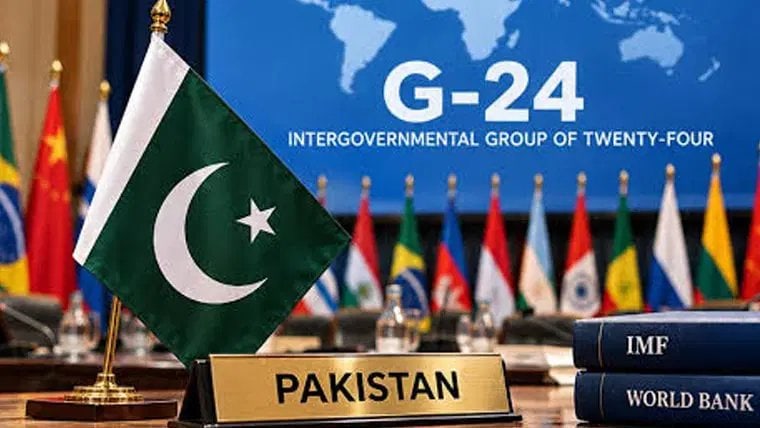
ISLAMABAD – Pakistan has stepped into global economic spotlight by taking over G-24 chairmanship from Nigeria. Finance Minister Muhammad Aurangzeb will now lead efforts to amplify the voice of developing economies and push for fairer financial policies at the IMF and World Bank.
The South Asian nation stepped into key leadership role in global economic diplomacy, formally assuming chairmanship of influential Group of Twenty-Four (G-24), a coalition of developing nations seeking a stronger voice in decisions made by the world’s most powerful financial institutions.
The development places Finance Minister Senator Aurangzeb at centre of major international effort to reshape global financial governance, secure fairer development financing and challenge inequalities facing emerging economies.
Pakistan took the driving seat after serving as group’s First Vice-Chair, at a time when developing countries are grappling with mounting debt, expensive borrowing, climate-related disasters and persistent economic instability. The leadership transition also brings Pakistan into a key coordinating role in discussions involving the International Monetary Fund (IMF), World Bank and other international financial stakeholders.
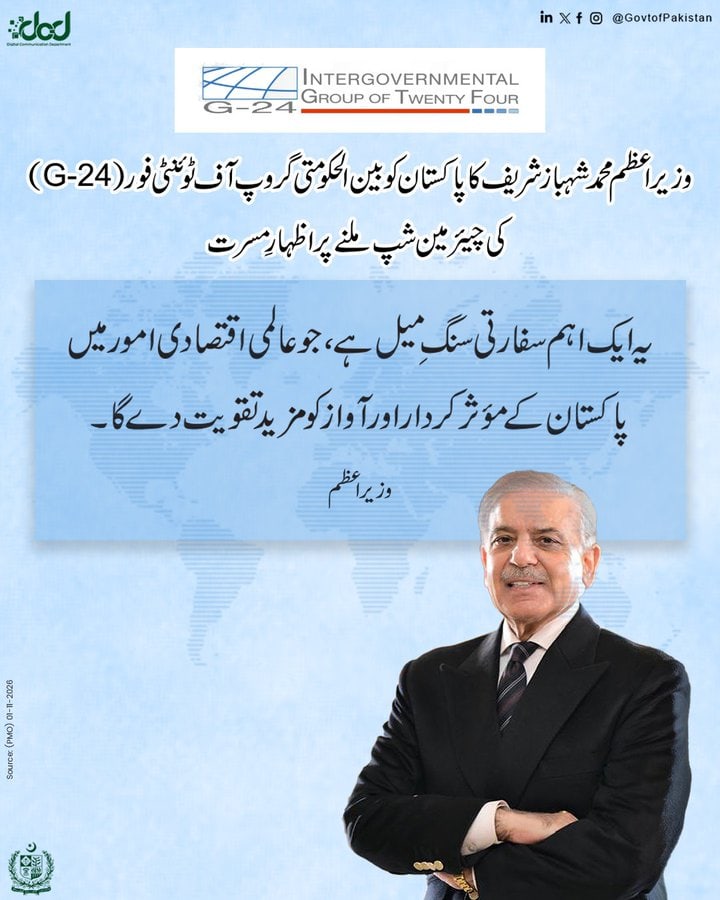
Prime Minister Shehbaz Sharif extends congratulations, calling it major diplomatic milestone, saying it reflected Pakistan’s growing engagement and standing in global economic affairs. He also praised Finance Minister Aurangzeb and the Ministry of Finance team for their efforts. However, the new responsibility comes with a major challenge: turning diplomatic influence into meaningful financial reforms for countries struggling to secure investment, manage debt and sustain economic growth.
Taking charge of the G-24, Finance Minister Muhammad Aurangzeb outlined three ambitious priorities designed to put the economic interests of developing nations at the forefront of international policymaking. His first objective is to move global financial discussions beyond short-term crisis management and place sustainable development at their centre.
According to the Finance Minister’s policy vision, macroeconomic stability should not be treated as the ultimate destination for struggling economies. Instead, it must create opportunities for investment, higher productivity, employment generation and broadly shared prosperity. The second priority is to strengthen the collective influence of emerging and developing economies within international financial institutions.
Pakistan intends to advocate for more equitable representation, particularly in the IMF, World Bank and other multilateral organisations whose policies significantly influence the economic prospects of developing countries.
G-24 is an influential platform through which developing countries coordinate their positions on international monetary, financial and development policies. Created by the Group of 77 in 1971 and formally established in 1972, the organisation was designed to ensure that developing nations could collectively present their concerns before major global financial institutions.
Pakistan to assume chairmanship of World Bank, IMF boards of governors for 2027
G-24 expanded beyond its original 24 members and now includes approximately 28 full member states from Africa, Asia, Latin America and the Caribbean. China participates as a special invitee, while other G-77 countries can join discussions. Its members include Pakistan, India, Iran, Brazil, Argentina, Algeria, Egypt, Mexico, Nigeria, the Philippines and South Africa, among others.
Although G-24 chairmanship is a diplomatic achievement, it does not give Pakistan direct control over IMF or World Bank decisions. The group operates through consultation, consensus-building and coordinated advocacy rather than independent financial or regulatory authority.
Consequently, Pakistan’s new position does not automatically increase its voting rights at international financial institutions, guarantee additional lending or provide access to special financial assistance. But , it can strengthen Islamabad’s ability to influence collective policy recommendations and bring developing-country concerns into prominent international discussions.