ISLAMABAD – Federal Minister for Water Resources Mian Muhammad Mueen Wattoo on Friday said the government would assess progress on water security over the coming year by looking at the reliability of water services, the benefits for farmers and how well communities are protected.
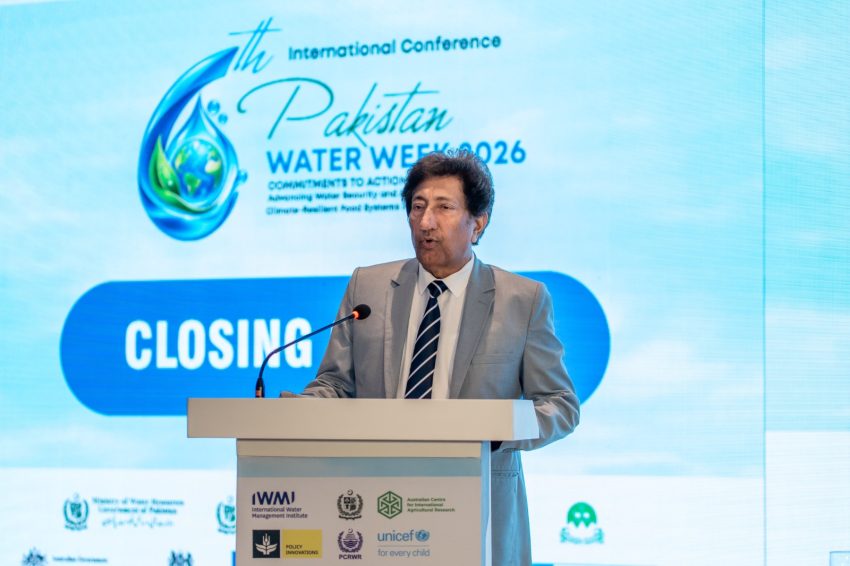
Speaking at the close of the sixth Pakistan Water Week in Islamabad, the minister urged organisers to turn the conference’s recommendations into programmes with clear indicators. He said the government was committed to pursuing water security through lawful, peaceful and evidence-based means.
Mr Wattoo called for assigning clear responsibility for implementing water policy, assessing water infrastructure by how well it performs and linking investment to gains in agricultural productivity. He also stressed the need to protect water quality and manage surface water and groundwater together.
The five-day conference brought together around 350 participants in person and more than 800 online across 26 sessions. The International Water Management Institute (IWMI) and the CGIAR Policy Innovations Science Program organised the event in collaboration with Pakistani government institutions and development partners. Discussions focused on water security and climate-resilient food systems.
Presenting the policy track’s findings, IWMI’s Johan Gély said Pakistan had the policies it needed but lacked the institutional arrangements to implement them, hold agencies accountable and use research in decision-making.
He called for a legal framework for groundwater management, updated assessments of water resources and infrastructure design standards, and wider use of nature-based solutions. He also proposed giving young people a formal role in water governance and establishing a prize for young innovators.
Claudia Ringler of the International Food Policy Research Institute said women, smallholder farmers and marginalised communities should help design the technologies and programmes meant to serve them. She called for national rules to help agencies share data, investment in the skills and infrastructure needed to use artificial intelligence and other digital tools, and changes to subsidies, credit and agricultural advisory services to expand the use of climate-smart irrigation.
Participants agreed to strengthen coordination among federal and provincial agencies responsible for water, agriculture, energy and disaster management. They also called for tracking water service reliability, agricultural productivity, groundwater levels and community resilience, and for regional cooperation on risks linked to changes in snow and ice in the upper Indus Basin.
IWMI’s strategic programme director for water, food and ecosystems, Mohsin Hafeez, said the institute would track progress on the recommendations over the coming year and report its findings at Pakistan Water Week 2027.