
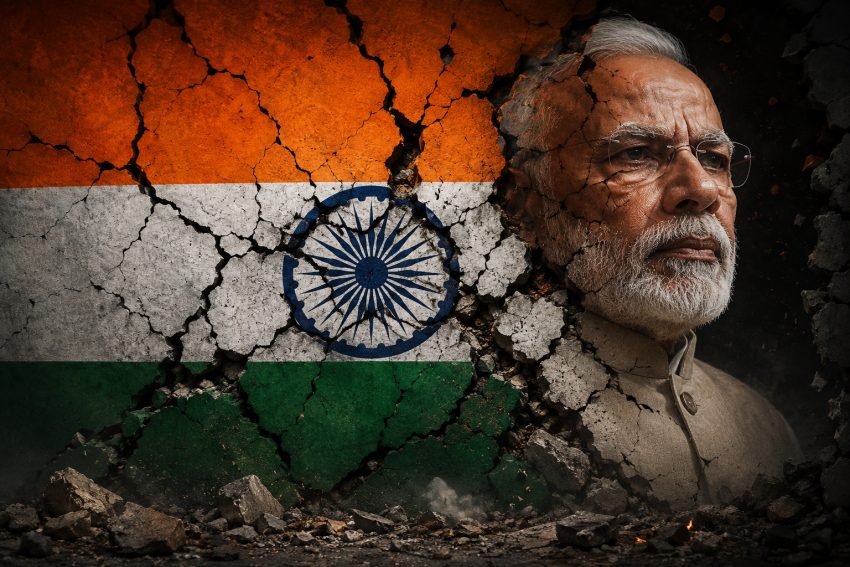
ISLAMABAD – Pakistani security officials had an entire high-level briefing, dismantling India’s internal challenges as Modi-led country’s greatest threats now come from within rather than from external adversaries.
The briefing highlighted how India as state increasingly burdened by political turmoil, social fragmentation, economic inequality, and institutional polarization. According to officials, India’s strategic model is built on coercion rather than public consent, with deepening divisions based on religion, caste, ethnicity, language, and regional identity steadily eroding national cohesion. They argued that these fault lines are widening instead of narrowing, pushing the country toward prolonged instability.
The briefing called caste system as a persistent structural challenge that continues to shape social status, rights, and opportunities, leaving millions marginalized. Officials also claimed that the growing influence of Hindutva and the continued “saffronization” of public institutions have strengthened majoritarian politics while shrinking space for diversity and pluralism.
Officials contrasted India’s social order with Islamic principles of equality, arguing that while Islam considers all human beings equal at birth, India’s caste-based hierarchy creates unequal social conditions from the outset.
It also highlighted unresolved political flashpoints across India, including Indian-occupied Kashmir, Manipur, Nagaland, the Seven Sisters, Khalistan, and the country’s widening North-South divide. According to the briefing, these regions continue to reflect unresolved political grievances and demands for greater autonomy or independence.
Security officials further alleged that New Delhi increasingly relies on confrontation with Pakistan to divert domestic attention away from mounting internal challenges instead of addressing the underlying causes of instability.
The briefing argued that the current trajectory validates Muhammad Ali Jinnah’s Two-Nation Theory, citing widening economic inequality, identity politics, religious polarization, and entrenched caste divisions as factors steadily weakening India’s national unity.
Officials also expressed concern over what they described as the “saffronization” of India’s military and state institutions, claiming that ideological influence within key national institutions has intensified and that the growing overlap between politics and the military has further deepened societal divisions.
On the foreign policy front, the briefing asserted that India’s doctrine of “strategic autonomy” is increasingly masking diplomatic uncertainty and an inconsistent strategic direction. It also claimed that strained relations with nearly all neighboring countries have reinforced perceptions of India as a source of instability in South Asia.
According to the officials, India’s own domestic and foreign policies have become its greatest national security vulnerability, weakening the country from within. They argued that as Pakistan’s international standing continues to improve, it is becoming increasingly difficult for India to conceal its internal political and social contradictions.