

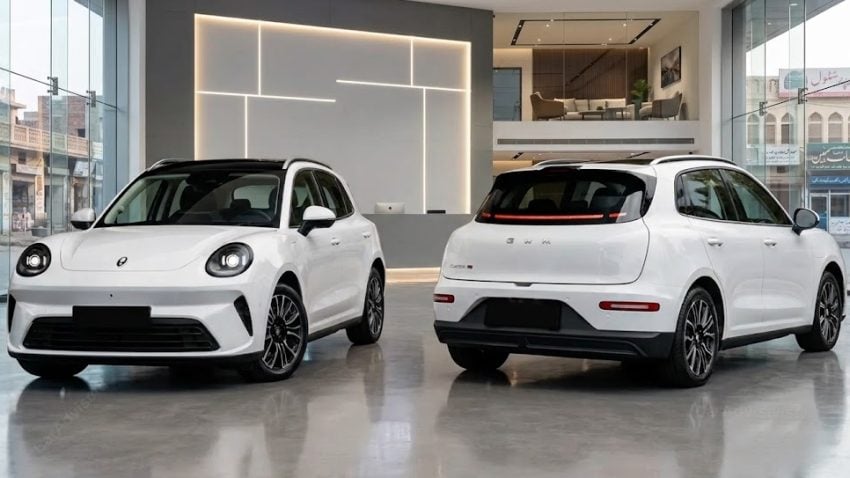
Pakistan’s car buyers are considering EV options amid push for Green Energy and massive travel cost. GWM is putting that future in showrooms with the ORA 5, a 435-km electric SUV priced at Rs8.6 million. It looks promising on paper, but in a country where charging infrastructure is still catching up, there are alot of question about its range or power and is it worth the price tag?
ORA 5 in Pakistan comes with 435-km range, backed by 58.3 kWh battery. The compact SUV, positioned between the existing ORA 3 and ORA 7, with a sizeable battery, decent performance, a long claimed driving range, and enough technology to make it a serious contender in Pakistan’s EV market.
With bookings now open at Rs1.7 million, buyers are being asked to make commitment to technology that still depends heavily on where they live, how far they drive, and, where they can charge.
The ORA 5 becomes the third member of GWM’s ORA family in Pakistan. ORA 3 occupies the smaller end of the lineup, while the ORA 7 sits above it. The ORA 5 fills the gap between them, giving buyers a larger, more SUV-oriented electric option without stepping all the way up to the ORA 7.
ORA 5 EV Features
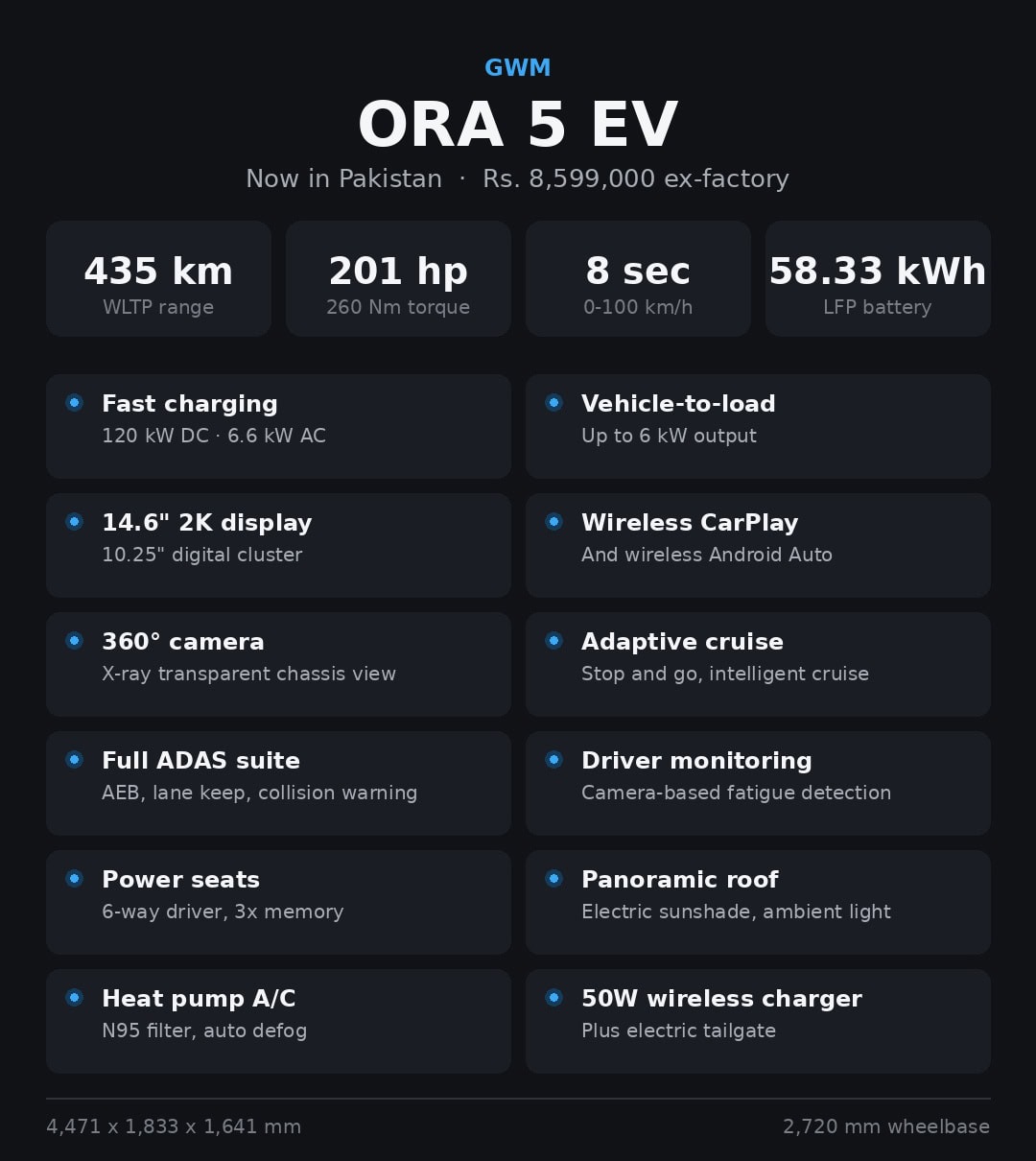
ORA 5 performance figures are not sports-car territory, but they’re more than respectable for a family-oriented electric SU, 0-100 km/h: 8 seconds. Power goes to the front wheels, keeping the ORA 5 focused on efficient everyday driving rather than outright performance.
The equipment list includes a big infotainment screen, a 10.25-inch digital instrument cluster, wireless Apple CarPlay and Android Auto, and 50W wireless phone charging. There’s also a 360-degree surround-view camera, which should be particularly useful in crowded urban environments.
The electric SUV brings driver-assistance technology including Adaptive cruise control, Lane-keeping assist, Automatic emergency braking and driver monitoring.
ORA 5 is not competing for the average Pakistani family looking for a replacement for a conventional budget car. It is going after buyers already shopping in the premium SUV market. Its immediate EV rivals include the BYD Atto 3 and Jaecoo J6, putting the ORA 5 directly into one of the most interesting battles currently developing in Pakistan’s automotive industry.
Electricity can be dramatically cheaper than petrol when you charge at home. Using 2026 off-peak residential tariff of around and EV consumption assumption of roughly 13 kWh per 100 km, charging at home can put the energy cost at approximately Rs 3-5 per kilometre.
Even under higher domestic electricity slabs, where rates can reach roughly Rs 22-47 per kWh, the effective cost can remain around Rs 6-10 per kilometre, depending on consumption.
Pakistan has made progress on EV charging tariffs. The government reduced the base electricity tariff for EV charging stations from around Rs 71 to Rs 39.70 per unit, a reduction of roughly 44%. But consumers don’t necessarily pay only the regulated electricity component. Operators can add charges to cover their operating costs, meaning actual public charging prices can be substantially higher.
Current market examples put public charging around Rs 110-120 per kWh, with some operators charging even more depending on location and charger type.
On paper, ORA 5 can travel 435 km on a full charge under the WLTP test cycle. But that doesn’t mean a Pakistani driver can casually set off on a 435-km road trip and forget about charging. Pakistan’s public EV charging network remains limited, with roughly 30-50 publicly accessible charging stations concentrated mainly around Karachi, Lahore and Islamabad.
Lahore-Islamabad journey requires more planning than the equivalent trip in a petrol car. A Karachi-Lahore road trip requires considerably more.
Pakistan’s NEV Policy 2025-30 includes plans for 40 Level 3 fast chargers on motorways, with proposed spacing of around 105 km. The policy framework is explicitly aimed at accelerating EV adoption and developing the supporting infrastructure needed for it.
Pakistan’s rapidly expanding rooftop solar market means some EV owners can effectively turn their home into a private fuel station, generating electricity during the day and using it to charge the car.
ORA 5 becomes a tougher proposition if you regularly travel long distances. If you’re constantly driving Karachi-Lahore, Lahore-Islamabad, or similar intercity routes, the charging network can still make life complicated.
For someone spending long hours behind the wheel, charging time is effectively downtime. Saving money on every kilometre doesn’t help much if the vehicle has to sit idle while the driver waits for the battery to recharge.
Pakistan’s affordable EV MG Binguo is here; Check Price and Specs here