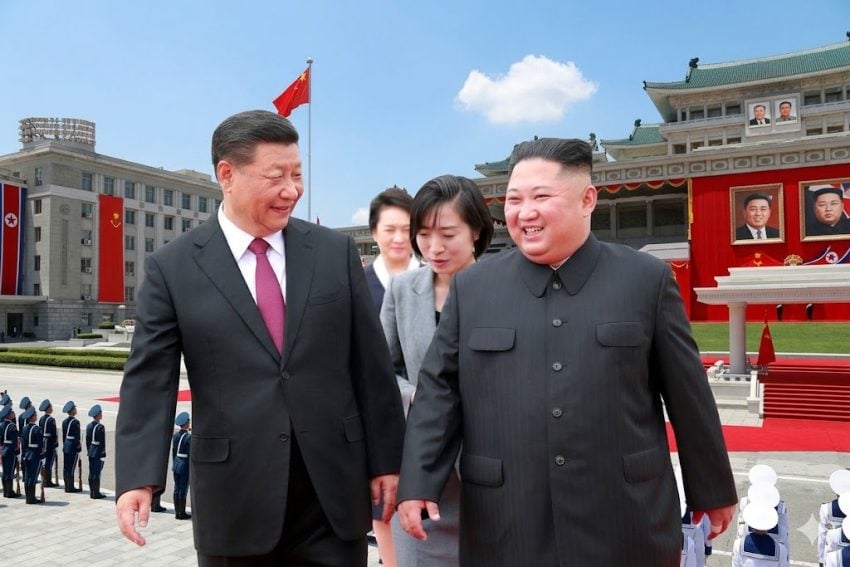
BEIJING — Chinese President Xi Jinping arrived in North Korea on Monday in his first trip to nuclear armed state in 7 years with renewed phase of engagement between Beijing and Pyongyang. Two sides continue to uphold one East Asia’s most enduring strategic partnerships, bound by history, ideology, and mutual security interests, even as Pyongyang seeks to diversify its alliances.
The ties, frequently described by both sides as “as close as lips and teeth,” dates back to the Korean War when China sent hundreds of thousands of troops to fight alongside North Korean forces. Two sides formalized ties in 1949 and sealed their bond with a mutual defense treaty in 1961, China’s only formal alliance, which remains active today.
Xi, accompanied by First Lady Peng Liyuan, was received with full state honours, including a 21-gun salute and a military band performing the national anthems of China and North Korea. North Korean leader Kim Jong Un and his wife Ri Sol Ju personally welcomed the Chinese delegation at the airport, according to Chinese state media Xinhua.
The two-day visit is expected to include summit between Xi and Kim Jong Un, the first between the two leaders since they met in Beijing during commemorations marking 80 years since Japan’s surrender in World War II.
Xi described China–North Korea ties as entering a “new historical starting point,” reiterating that strengthening bilateral ties remains a consistent policy priority for the Chinese Communist Party.
China has long been North Korea’s principal economic partner, historically accounting for up to 95 percent of its trade. However, the regional balance has shifted since Russia’s invasion of Ukraine in 2022, with Pyongyang expanding military cooperation with Moscow, including reported transfers of weapons, artillery, and personnel.
Beijing is seeking to reassert its influence over North Korea amid concerns over Pyongyang’s growing alignment with Russia. The visit is also seen as part of China’s broader effort to reinforce its strategic position in Northeast Asia as competition with the United States intensifies.
During talks, Xi is expected to discuss possible economic cooperation, including food and fertiliser assistance, the resumption of Chinese group tourism to North Korea, and potential joint development projects between the two countries.
Economically, North Korea relies heavily on its larger neighbor. China accounts for roughly 90 to 98 percent of North Korea’s foreign trade, supplying critical oil, food, and essential goods that have helped the isolated regime survive international sanctions and prolonged border shutdowns.
Korean state also serves as key buffer for China, keeping US troops and their South Korean and Japanese allies at a distance from the Chinese border. Beijing has consistently prioritized stability in Pyongyang over full denuclearization, fearing that a regime collapse could trigger massive refugee flows and regional instability.
While the alliance faced strains, particularly during periods of aggressive North Korean nuclear and missile testing, high-level diplomacy has often helped repair ties.
North Korea doubles down on Nukes as Kim Jong Un blasts US ‘State Terrorism’