
ISLAMABAD – Pakistan’s economic diplomacy went into overdrive as Finance Minister Senator Aurangzeb took center stage at the IMF–World Bank Spring Meetings in Washington, D.C., holding whirlwind of high-stakes meetings with global financial power players, investors, and policymakers.
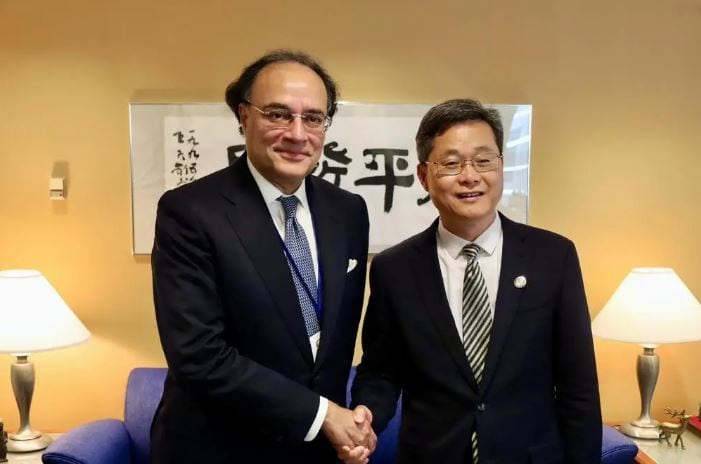
In headline-grabbing engagement, Aurangzeb called on China’s Finance Minister Lan Fo’an, where he openly praised Beijing’s unwavering backing of Pakistan and its influential role at the IMF. He revealed that Pakistan is on the brink of securing IMF Board approval for key programme reviews in early May—marking a critical moment for the country’s economic recovery. He also spotlighted Pakistan’s ambitious financial moves, including its first-ever Panda Bond and a sharp rise in trade conducted in Chinese currency, pushing for an expanded currency swap deal to fuel growing bilateral trade.
In talks with Pan Gongsheng, Aurangzeb laid out Pakistan’s aggressive policy response to economic shocks triggered by ongoing regional tensions, including targeted subsidies and strict demand-control measures.
Aurangzeb held a crucial meeting with Alvaro Lario of the International Fund for Agricultural Development. He candidly admitted deep-rooted structural weaknesses but unveiled a bold reform agenda focused on overhauling leadership, boosting capacity through global training, and deregulating key commodity markets.
FinMin pushed for tighter alignment between IFAD programmes and Pakistan’s top-level policy planning, even proposing direct coordination with the Prime Minister’s Agricultural Task Force. Both sides explored game-changing financing models involving private investment and potential co-funding from major institutions like the World Bank and Asian Development Bank—while warning of looming fertilizer supply risks amid global disruptions.
Aurangzeb presented Pakistan’s economic roadmap, emphasizing efforts to stabilize the macroeconomic outlook and secure external financing. He outlined a strategy to reduce reliance on traditional funding by tapping into Panda bonds, Eurobonds, and local-currency instruments to shield the economy from foreign exchange shocks. Both sides stressed the urgency of maintaining exchange rate flexibility and protecting fiscal space as global uncertainty intensifies.
He also engaged with top-tier institutions including Moody’s, Rothschild & Co., and the OPEC Fund for International Development, signaling Pakistan’s push to rebuild investor confidence. He also took the stage at a high-profile J.P. Morgan seminar on Pakistan’s economic and monetary outlook, while actively shaping the global narrative through interactions with leading international media outlets.