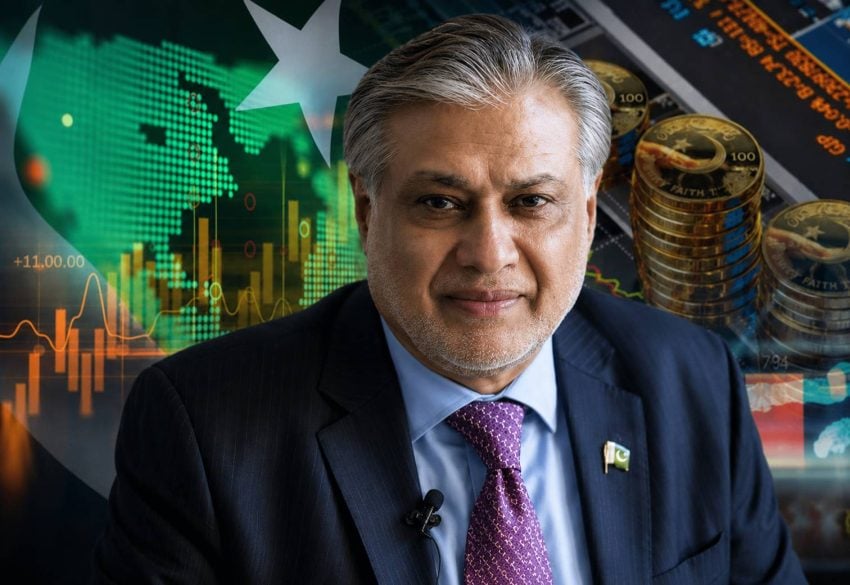
ISLAMABAD – Islamabad’s political corridors are buzzing with speculation that major cabinet reshuffle could follow in the coming days, with name of Deputy Prime Minister Ishaq Dar once again dominating discussions for the coveted role of finance czar .
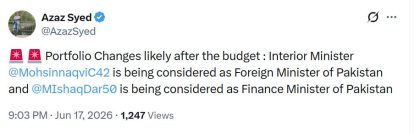
A tweet shared by journalist Azaz Syed said Interior Minister Mohsin Naqvi is being considered for Foreign Ministry, while Deputy Prime Minister Ishaq Dar could be brought back to the Finance Ministry.
Seniro TV host and analyst Kamran Khan said there has been no decision or even any consultation about replacing Muhammad Aurangzeb as Minister for Finance and Revenue, quoting an official source.
Aurangzeb continues to enjoy full confidence of Prime Minister, as well as other senior figures in the government who are routinely consulted on matters of critical importance,” the same well-informed source further confided, the post said.
“There has been no decision or even any consultation about replacing Muhammad Aurangzeb as Minister for Finance and Revenue,” an authoritative official source told me a short while ago.
“He continues to enjoy the full confidence of the Prime Minister, as well as other senior… pic.twitter.com/cO3WNsB6bw
— Kamran Khan (@AajKamranKhan) June 17, 2026
As the post sparked buzz online, there is no official confirmation or denial from the government side, with users calling it speculation.
For Pakistan, Ishaq Dar’s comeback means a bigger change, especially when the government is rolling out new stern measures to revive $452 economy. Across four separate terms as Finance Minister, Dar jholds finance portfolio, as he claimed controlling inflation through intervention and to use international financing to stabilize the economy.
Ruling party members credit him with negotiating IMF support, boosting foreign exchange reserves, and steering Pakistan through repeated economic storms. They argue that when financial pressure mounted, Dar was often the man trusted to take charge.
Critics, however, argue that his economic model relied too heavily on borrowing, maintained an artificially strong rupee, and failed to address deeper structural problems such as tax reform, fiscal discipline, and export competitiveness. To them, Daronomics provided temporary relief while pushing difficult decisions into the future.
The speculation comes at a crucial moment. Pakistan’s economy remains tied to IMF-backed fiscal targets, with the government focusing on revenue generation, debt management, and economic stability in the wake of a challenging budget cycle.