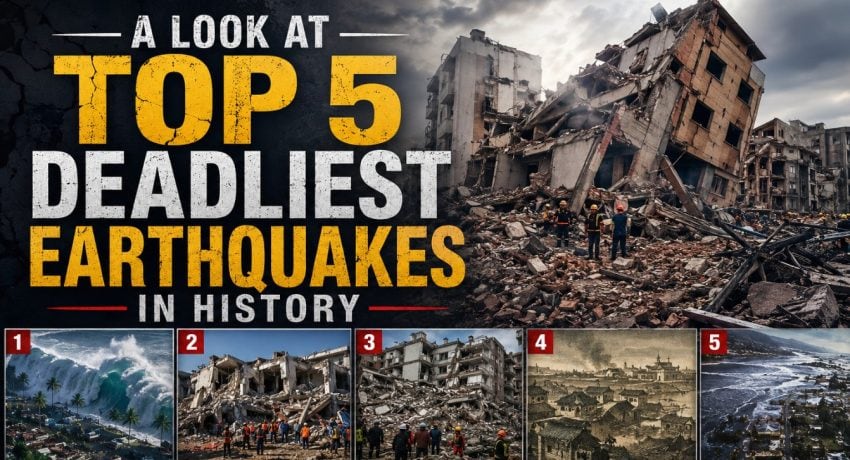
ISLAMABAD – A series of powerful earthquakes struck Venezuela, leaving widespread destruction in its wake, with rescue workers racing against time to search for survivors beneath collapsed buildings. While officials continue to assess scale of the disaster, early reports suggest the death toll could rise significantly as emergency crews reach the hardest-hit areas.
The twin earthquakes occurred within a minute of each other, damaged thousands of buildings and disrupted daily life across affected regions. Hospitals, emergency responders and volunteers remain engaged in large-scale rescue and relief operations.
As Venezuela confronts the aftermath of a catastrophic seismic event, the disaster revived memories of some of deadliest earthquakes in history, as these events reshaped nations and claimed hundreds of thousands of lives.
Indian Ocean Earthquake and Tsunami (2004)
On December 26, 2004, a magnitude 9.1 undersea earthquake struck off the coast of Indonesia, triggering one of the deadliest tsunamis ever recorded.
Towering waves swept across the Indian Ocean, devastating coastlines in 14 countries, including Indonesia, India, Sri Lanka and Thailand. Entire communities were washed away, leaving an estimated 230,000 people dead and millions displaced. The disaster remains one of the worst natural catastrophes of the 21st century.
Haiti Earthquake (2010)
Haiti was struck by a catastrophic earthquake on January 12, 2010. Although the quake occurred at a relatively shallow depth of around 13 kilometres, its proximity to densely populated areas made the destruction particularly severe.
More than 2Lac people lost their lives, over 300,000 were injured, and nearly 1.5 million residents were forced from their homes. Countless buildings collapsed, overwhelming emergency services and prompting one of the largest international humanitarian responses in recent history.
Turkey–Syria Earthquake (2023)
On February 6, 2023, a magnitude 7.8 earthquake hit southern Türkiye near the Syrian border, followed by powerful aftershocks that compounded the devastation.
Entire neighbourhoods crumbled as families were trapped beneath the rubble. According to official figures, approximately 34,000 people were killed, while more than 94,770 others were injured. The disaster underscored the seismic risks faced by one of the world’s most active earthquake zones and triggered a massive international relief effort.
China’s Shaanxi Earthquake (1556)
History’s deadliest known earthquake struck China’s Shaanxi Province on January 23, 1556.
Estimated to have measured around magnitude 8.0, the earthquake devastated vast areas across Shaanxi, Shanxi, Henan and neighbouring regions. Historians believe more than 800,000 people lost their lives, making it the deadliest earthquake ever recorded in terms of fatalities.
Valdivia Earthquake, Chile (1960)
The strongest earthquake ever measured by modern instruments occurred in Valdivia, Chile, on May 22, 1960. Registering a record-breaking magnitude of 9.5, the earthquake felt across Pacific Ocean, reaching countries including Japan and the Philippines.
Despite its extraordinary strength, the death toll was estimated at around 1,600—far lower than many less powerful earthquakes—highlighting how factors such as population density, building standards and preparedness can significantly influence the human impact of seismic disasters.
Earthquakes strike without warning, often turning ordinary moments into unimaginable tragedies within seconds.
Twin earthquakes rock Venezuela, leaving 32 dead; hundreds missing