

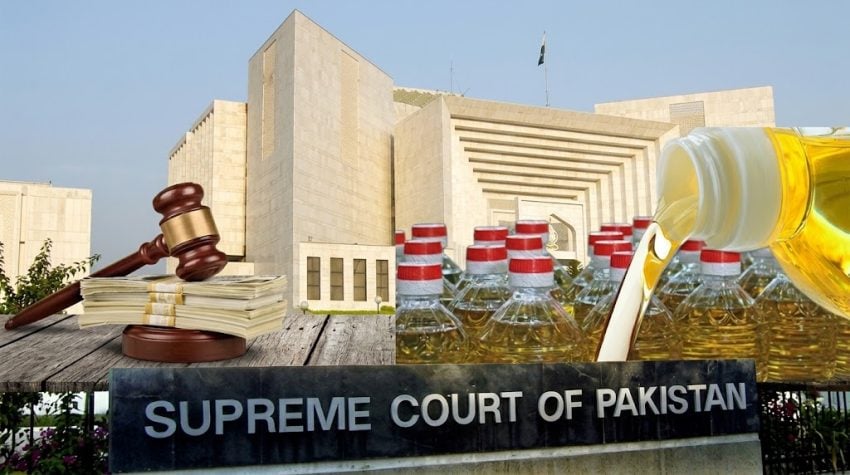
ISLAMABAD – A prolonged price-fixing dispute finally reached Supreme Court, with the top court upholding the violation against the ghee and cooking oil manufacturers’ association while reducing penalty to Rs30 million.
Supreme Court ruled that Pakistan Vanaspati Manufacturers Association (PVMA) violated competition law by coordinating prices of ghee and cooking oil among competing companies.
A two-member bench comprising Justice Jamal Khan Mandokhail and Justice Salahuddin Panhwar upheld the core findings of the Competition Commission of Pakistan (CCP) and the Competition Appellate Tribunal (CAT), but reduced the penalty imposed on PVMA from Rs50 million to Rs30 million. The court directed the association to deposit the revised Rs30 million fine.
The case dates back to 2007-09, when the federal government held discussions with PVMA as part of efforts to bring down the prices of ghee and cooking oil. PVMA participated in the talks and later communicated the prices agreed during those discussions to its member companies.
The commission concluded that the association effectively negotiated and determined prices on behalf of competing manufacturers. It found the practice in violation of Section 4(1), read with Section 4(2)(a), of the Competition Act, 2010. The commission also imposed Rs50 million penalty, which was later upheld by the Competition Appellate Tribunal.
In its judgment, Justice Jamal Khan Mandokhail made it clear that rival businesses must independently decide how much they charge for their products. The court said companies are expected to base pricing decisions on their own commercial interests and market conditions. A trade association cannot step in and establish a common price for competing businesses.
The judges warned that collective pricing can weaken competition by removing the pressure on individual manufacturers to compete with one another.
Supreme Court also turned out argument that collectively agreed prices become lawful simply because they are lower and potentially beneficial for consumers. The judgment emphasized that the process used to determine prices matters. Even an arrangement intended to reduce prices can violate competition law when competing businesses collectively establish those prices instead of making independent decisions.
According to the court, healthy competition itself can push businesses to offer more attractive prices, ultimately benefiting consumers.
The court further ruled that claims of public benefit cannot override competition rules. Even where an arrangement is presented as an effort to protect consumers or reduce the cost of essential commodities, businesses must continue to comply with the Competition Act. Apex Court therefore maintained the CCP’s main finding against PVMA but granted partial relief by cutting the financial penalty by Rs20 million.
SC fines man Rs500,000 for initiating baseless case against ex-wife