
IT is a tragedy of grim proportions that the economic livelihood of the Afghan people is being held hostage by the ideological intransigence of their own rulers. The unfolding crisis on the Pakistan-Afghanistan border is not merely a dispute over tariffs or transit documentation; it is the inevitable consequence of the Taliban regime’s refusal to align statecraft with regional security realities.
By prioritizing the protection of militant proxies over the welfare of its merchant class, Kabul has plunged its economy into a tailspin, a situation fueled by what can only be described as the regime’s persistent hat dharmi (obstinacy).
The economic logic, corroborated by Afghan sources, is indisputable. Data from Afghan media outlet Amu TV dismantles the narrative that Kabul can easily bypass Pakistan. Port of Karachi remains the singular, viable lifeline for the landlocked nation. A container routed through Karachi reaches Kabul in three to four days at an average cost of $2,000. In contrast, the much-touted alternative of Iran’s Chabahar Port doubles the financial burden to $4,000 per container and extends the transit time to a sluggish seven or eight days.
For a fragile economy, this 100 per cent inflation in logistics costs is lethal. Alternatives like the northern routes to Russia take up to 25 days, rendering them useless for perishables, while air corridors remain an expensive novelty. Yet, despite these glaring realities, the trade deadlock continues because Kabul refuses to acknowledge that the era of the ‘grey economy’ is over. Pakistan has institutionalised a hard border regime: the smuggling of goods is unequivocally banned, and the specialized documentation systems are being enforced without exception. The illicit trade that once enriched warlords and deprived the Pakistani exchequer is being systematically choked off.
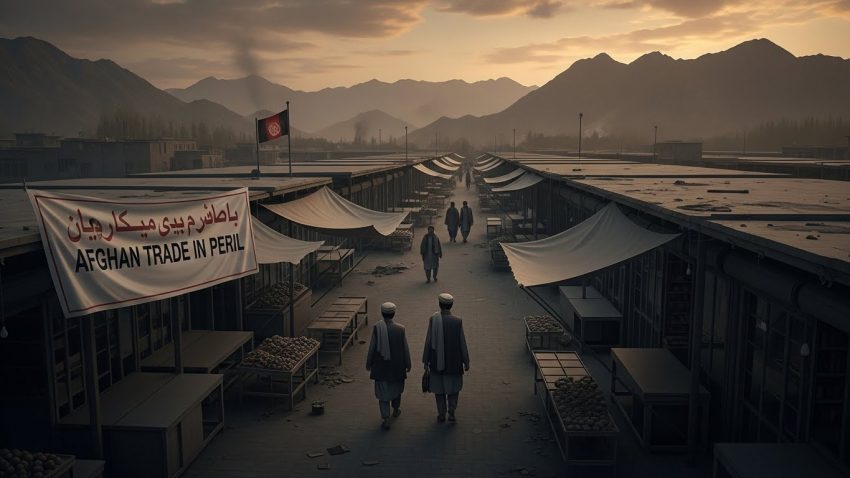
These are not just statistics; they are lives upended. The deafening silence at the Afghan Board Market tells a story of immediate desperation, where 7,000 business owners face ruinous losses as their inventory runs dry. The shockwaves have travelled straight to the fields of Kandahar. Here, the blockade has hit the agricultural sector with the force of a natural disaster. Denied their main export route, farmers are watching their premium pomegranate harvest rot, stripping them of their season’s income and plunging thousands of rural dependents into financial peril.
However, the growing economic paralysis facing the agricultural and business communities seems to register as a mere footnote in Kabul’s strategic calculus. Islamabad has thus drawn a red line. Pakistan’s position is stripped of ambiguity: normal trade relations are contingent upon a singular demand. The Afghan interim government must dismantle the terrorist infrastructure serving the Tehreek-i-Taliban Pakistan (TTP). Until these guests of the state—who arm themselves against Pakistan—are evicted, there is no diplomatic or economic space for compromise.
The time for ambiguity is over. No state should be expected to bankroll its own destabilization by trading with a neighbour that harbours its enemies. The equation is brutally simple: security comes first. Pakistan has drawn a line in the sand and has made it clear that it will not budge, regardless of the economic fallout. The gates of Karachi are locked, not out of spite, but out of survival. The ball is now in the Taliban’s court, and they must make a binary decision—protect their proxies in the TTP or feed their starving population. There is no middle ground left.