
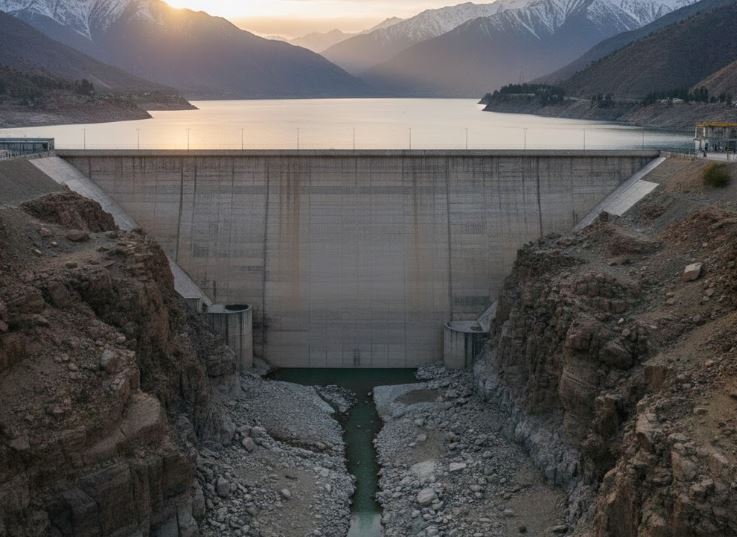
ISLAMABAD – Indian government after unilaterally revoking Indus Waters Treaty (IWT), approved Dulhasti Stage II hydropower project on the Chenab River in occupied Jammu and Kashmir in another blatant violation of the Indus Waters Treaty.
As water remaisn lifeline for more than 250 million people, most of whom live in Pakistan, the project, located in the region under India’s control, is set to produce up to 260 megawatts of electricity. Modi government’s final approval ignited tensions, with experts warning that the development could pose serious strategic and defensive risks for Pakistan, given that the Chenab River is allocated to it under the historic treaty.
With an estimated cost of 327.745 billion INR, construction on the massive project is said to start in 2026. India’s state-owned NHPC Limited will lead development
Dulhasti Stage II will utilize existing infrastructure of the Dulhasti Stage I project, which generates 390 megawatts and operated under a run-of-the-river system since its completion in 2007. The same dam, reservoir, and power intake will be employed in the new phase, raising concerns over India’s increasing.
‘Diverting Water Act of War’
Pakistan on the other hand warned earlier that any attempt by Delhi to divert or block water under the Indus Waters Treaty would be treated as an act of war.
Islamabad announced sweeping retaliatory measures as the government immediately suspended 1972 Simla Agreement and closed the Wagah border—the only legal crossing between the two countries.
Trade with Delhi has been stopped entirely, including goods routed through third countries, while Pakistan closed its airspace to all Indian-owned or Indian-operated airlines. All visas issued under the SAARC Visa Exemption Scheme were also suspended in a mirror response to India’s move.
Pakistan’s official statement condemned India’s unilateral action, stressing that Indus Waters Treaty is binding international agreement brokered by the World Bank, with no provision for suspension. “Water is a vital national interest for Pakistan, sustaining 240 million people,” the statement read. “Any attempt to stop or divert Pakistan’s water under the treaty will be treated as an act of war and met with a full-spectrum response across all national power.”
The statement declared that Pakistan would exercise its right to suspend all bilateral agreements with India, including the Simla Agreement, until India ends what Islamabad calls support for cross-border terrorism, transnational killings, and violations of international law and UN resolutions on Kashmir.