

As a researcher deeply embedded in the mechanics of modern warfare, I spend my time tracking anomalies. Sometimes, these anomalies are malicious codes injected into terrestrial broadcast servers, as we recently saw with our media networks. But more often than not, they are malicious narratives deliberately injected into the global public consciousness. We live in an era of dual-domain warfare. The moment an artillery shell lands on the physical battlefield, a million manufactured lies are launched into cyberspace.
Right now, Pakistan is fighting a very real, highly kinetic war on its western borders under Operation Ghazb-lil-Haq. And simultaneously, we are batting back a relentless, coordinated campaign of digital fiction.
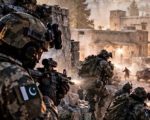
To understand the scale of the disinformation, you must first understand the ground reality. By 1500 hours on March 2nd, the tactical outcomes of Operation Ghazb-lil-Haq were not just decisive; they were devastating for the adversary. The Pakistani military systematically dismantled hostile infrastructure. The Afghan Taliban suffered catastrophic losses: 435 militants killed, over 630 severely injured, 31 outposts entirely captured, and an astounding 188 check posts obliterated. A staggering inventory of 188 tanks, armored vehicles, and artillery guns were reduced to scrap metal. Across Afghanistan, 51 critical operational hubs were effectively targeted and neutralized from the air.
When a militant entity faces structural decimation on this unprecedented scale, a fascinating psychological shift occurs. Unable to win the physical fight, they pivot frantically to the internet to engineer a mirage of victory. Since Operation Ghazb-lil-Haq began, the adversary’s strategy has been simple: flood the zone with fake stories to camouflage their hemorrhaging frontlines. While we continuously debunk these claims, their latest fabrication is a masterclass in global disinformation syndicates.
The claim went viral like a contagion: a coordinated network suddenly announced that the Afghan Taliban had launched “precise, deep-penetrating drone and airstrikes” inside Pakistan. The mythical targets included the heavily fortified Nur Khan Airbase in Rawalpindi, the 12 Corps Headquarters in Quetta, and critical sites across Khyber Pakhtunkhwa, Mohmand, and Balochistan.
As a professional analyst assessing the kill-chain of this rumor, the mechanics of the lie were glaringly transparent. The Afghan Taliban’s Ministry of Defence first fired a vague, boastful post regarding “precise aerial operations.” Instantly, a recognized fake social media handle operating as “BRICS News” amplified the claim. From there, Indian media channels—most notably Republic TV, pushing the “Pak-Afg Sit” tag—hyperventilated the narrative to millions. To make it sound legitimate, they cited “TASS” as the source. They boldly declared Pakistan’s advanced air defenses had collapsed, fabricated tales of civilian unrest in Karachi and Skardu, claimed troops were captured, and bizarrely insisted that the military’s silence “proved” the strikes succeeded.
Now, let us bring military logic and data-driven reality into this theatre of the absurd.
First, let us examine the supposed “source.” A basic intelligence sweep confirms the Russian state agency TASS has carried no such report; it was a total fabrication. Furthermore, the chaotic photo and live-action footage broadcasted by Indian media and the “BRICS News” account is a verifiable stock image of a generic, unrelated airbase. It possesses absolutely no geolocation markers linking it to Pakistani soil.
Second, the very concept of the Afghan Taliban executing a sophisticated deep-strike aerial campaign defies the basic laws of military physics. The Taliban inherited a crippled fleet in 2021 with zero sustainable logistical support. They possess absolutely no operational air force, nor the highly advanced command-and-control capacity required to pilot drones hundreds of miles deep into another sovereign nation’s airspace.
Furthermore, asserting that this phantom air force evaded the dense, overlapping, and technologically supreme air defense shields protecting Nur Khan Airbase is a premise suited for science fiction, not defense analysis. There was no intrusion. Commercial flights operated on schedule, and civilian life surrounding the Chaklala perimeter continued entirely unbothered.
Perhaps the most glaring piece of evidence is the silence of the very civilians the propaganda claimed were panicked. In today’s era, every citizen holds a high-definition smartphone camera in their pocket. If a coordinated airstrike occurred in the heart of Rawalpindi or Quetta, there would be tens of thousands of raw videos uploaded to TikTok and X within seconds. There were none. Similarly, highly reputable global intelligence bureaus and international press—such as Reuters, BBC, and AP—are closely monitoring this region. None reported an Afghan airstrike, though they extensively detailed Pakistan’s precise aerial counter-strikes.
What we are witnessing is a deeply synchronized disinformation syndicate. It operates symbiotically: the Taliban issues a fantastical boast to obscure the reality of 435 body bags and 188 burning tanks. Instantly, Indian media laundering hubs blindly amplify the fiction without a shred of evidence—no satellite imagery, no flight data, no ground video—specifically to fulfill an inherent desire to project Pakistan as fractured or vulnerable.
The verdict on this claim is absolute: it is unverified, militarily implausible, and patently absurd propaganda.
The digital frontlines are the new battleground of the 21st century. The adversaries we face—whether utilizing ad-injection to hack television networks or using Indian newsrooms to hack public perception—share the exact same goal: subverting Pakistan’s internal cohesion. The Pakistani forces have emphatically proven their dominance on the physical battlefield in Operation Ghazb-lil-Haq. Now, as citizens, it is our sovereign duty to maintain absolute vigilance on the digital battlefield, rejecting weaponized illusions and trusting only the undeniable weight of empirical truth.