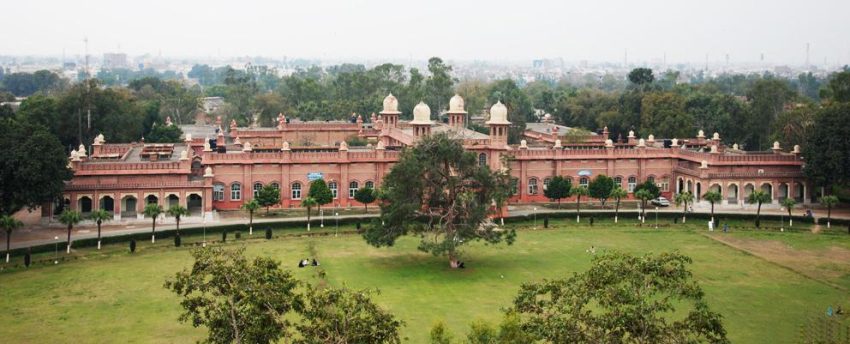
Every year in May, the world observes International Museum Day – a moment to celebrate institutions that guard our collective memory and build bridges between past and future. This year, as museums globally open their doors with renewed purpose, the University of Agriculture Faisalabad (UAF) has an extraordinary story to tell. Within its oldest standing edifice – the 1906 Bhai Ram Singh Building, the very birthplace of formal agricultural education in Indo-Pak Sub-continent – a quiet but historic transformation is underway. What was once the Punjab Agricultural College is being reborn as Pakistan’s first dedicated Food and Agriculture Museum, a project decade in the making, driven by a singular vision and now gathering tangible momentum. The historic building comprises several components, including a prominent central structure featuring a large hall and two flanking wings which are surrounded by a distinctive D-shaped grassy ground spanning approximately 10 acres, creating a unique and picturesque landscape for students and visitors
The idea of a museum on this institutional premise is not new. During the days of the Punjab Agricultural College, a small-scale museum already existed, as fondly reminisced by the legendary and historically knowledgeable Prof. Dr. Hafiz Abdul Qayyum, a 101-year‑old former UAF alumnus, during an interview with the author. He particularly recalled that the Old Museum was headed by Puran Nand Aolakha (1934-1946), who lived on the college premises. Aolakha’s son later rose to the rank of brigadier in the Indian Army. During a visit to UAF, the younger Aolakha announced four to six scholarships in memory of his late father, which have since been awarded to deserving, needy students. Later, in 1961, after the institution was elevated from a college to a university, the university continued to house a modest but valuable Zoological Museum. Initially managed by the Departments of Zoology and Entomology, its early specimens were first displayed in the corridor of the Chemistry Department. Later, the collection – which includes rare fossils, taxidermy-mounted animals, and skeletal structures – was relocated to the central hall of the historic building, where it has been maintained by the Department of Zoology, Wildlife and Fisheries. Many of its invertebrate specimens, preserved in sealed glass containers, were originally imported from Germany, the United Kingdom, and the United States. The collection represents faunal diversity from both North American and subcontinental ecosystems, including complete skeletons obtained from local markets. However, this valuable collection remained largely hidden, and the 120-year-old building, once a symbol of academic excellence, had gradually become underutilized, unsuitable for modern classrooms or labs. Its architectural grandeur, meanwhile, stood waiting for a new purpose. Recognizing its profound heritage value, the university, under Section 4(P) of the UAF Act 1973, has conceived a plan to repurpose the structure as a state-of-the-art agriculture museum.
That purpose was first envisioned with clarity and passion by Prof Dr. Iqrar Ahmad Khan, the former Vice Chancellor of UAF and currently the Chairperson of the Punjab Higher Education Commission (PHEC). Dr. Khan, who is recognized as the “dreamer” of this initiative, conceived the idea of converting the historic college building into a five-star Food and Agriculture Museum – the first of its kind in Pakistan. It was under his leadership that the 293rd meeting of the University Syndicate, held on September 7, 2013, formally approved the proposal to transform the building into an agriculture museum showcasing scientifically and historically significant specimens. He envisioned a space where a farmer’s ingenuity, a student’s curiosity, and a researcher’s quest for innovation could meet under one roof. Although the project received administrative approval from the Government of Punjab in 2017, it was capped in 2018 due to funding constraints and political motives. Yet, his vision never faded.
Today, the project has gained tangible momentum. Partial funding was secured through the “Establishment of Pak–Korea Nutrition Center (PKNC)” project, approved by the Higher Education Commission in collaboration with the Republic of Korea. Under this initiative, Rs. 243.399 million has been allocated for civil works to restore and renovate the historic building. The restoration is now in its final phase of completion. A professional museum interior designer has been engaged, a master plan has been developed, and content for 20 individual galleries is being finalized. The university has also formally established a Directorate of Food and Agriculture Museum, with its Board of Governors constituted and Rules of Business notified. The remaining galleries and on-ground execution will proceed once the full required funding – estimated – is made available. This momentum has transformed Dr. Khan’s dream from a concept into a near-reality, breathing new life into the 120-year-old building.
Adding further force to this initiative was the invaluable contribution of Prof Dr. Andreas Burket, a German academic and researcher. Dr. Burket played a decisive role in retrieving a priceless collection of old photographs of the university from the British Library. These images, dating back to the Punjab Agricultural College era, capture the original architecture, early farming practices, and the daily life of the institution over a century ago. Thanks to his painstaking efforts, these historical visuals were brought back to Pakistan and projected into the public eye during the formal launching ceremony of the Food and Agriculture Museum on October 9, 2024. At that landmark event, the Hon’ble Provincial Minister for Higher Education, Rana Sikandar Hayat Khan, inaugurated an exhibition of these very photographs – a moving tribute to the institution’s deep-rooted past and a powerful glimpse of what the museum will preserve for the future. Dr. Burket’s work did more than recover images; it threw crucial momentum behind the museum initiative, proving that heritage, when reclaimed, can inspire a nation.
When fully realized, the Food and Agriculture Museum at UAF will be a landmark of national pride. It will be the first museum of its kind in Pakistan and among the largest in the country, with an indoor display area of 55,000 square feet and an outdoor area of 32,000 square feet. Visitors will walk through 30 plus indoor galleries and a Hall of Fame, exploring everything from traditional farming tools and indigenous seeds to modern innovations like hydroponic and greenhouse models. The museum will also house specialized learning facilities, including a Herbarium, a Flora and Fauna Center, a Discovery Center, and interactive digital exhibits using VR, audio guides, and projection systems. Outdoors, a traditional village setup, a café area with life-size animal sculptures, and demonstration models of modern crop production await visitors.
As International Museum Day approaches each May, the global theme reminds us that museums are more than repositories; they are engines of education, sustainable development, and cultural tourism. The UAF museum aligns perfectly with that spirit. It directly supports the Punjab Growth Strategy and several UN Sustainable Development Goals, including Quality Education (SDG 4), Zero Hunger (SDG 2), Decent Work and Economic Growth (SDG 8), and Sustainable Cities and Communities (SDG 11). Beyond preserving artifacts, the museum aims to inspire young Pakistanis to see agriculture not as a fading tradition but as a dynamic, science-driven, and promising career field. It will attract schoolchildren, farmers, researchers, and international visitors, creating employment in tourism and hospitality while positioning the region as a compelling stop along CPEC’s corridors.
Standing on the scenic 10-acre D-shaped ground, surrounded by the timeless architecture of Bhai Ram Singh, the old building is finally returning to its original mission: to educate, to inspire, and to connect generations. And when Pakistan’s first Food and Agriculture Museum opens its doors, it will honour a visionary former Vice Chancellor, a helpful German professor who reclaimed forgotten history, and a century-old legacy that never died – arriving just as the world celebrates another International Museum Day.