
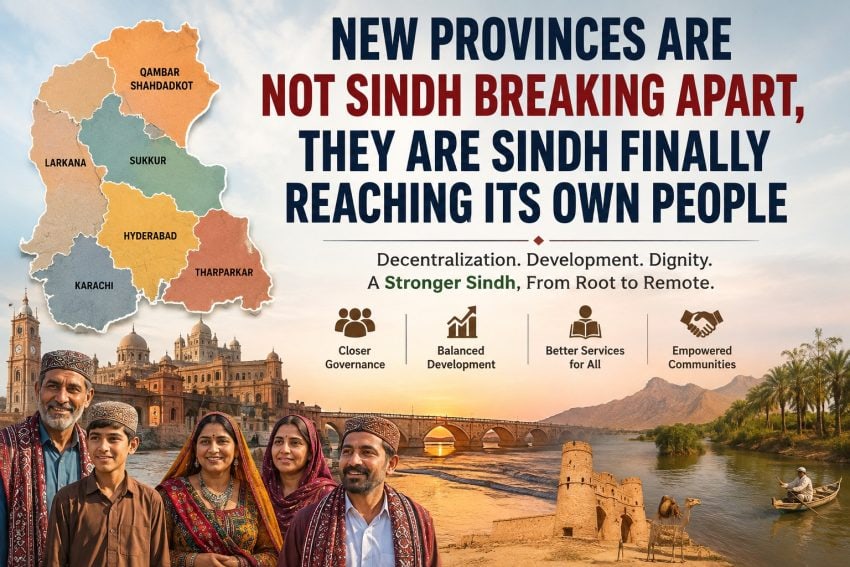
Say the words “new province” in Sindh and watch the reaction. People hear it as a plan to cut the province into pieces and hand parts of it away. That fear is genuine, but it misreads what is actually being proposed. Nobody serious is talking about handing Sindh’s land to another province or erasing its identity. What is on the table is authority moving down, from a handful of departments sitting in Karachi to district and divisional administrations, run by the same Sindhi officials and elected by the same Sindhi voters, just closer to the people they are supposed to serve. So where did the idea that this means tearing Sindh apart even come from? Mostly from people repeating a slogan without checking what it actually describes.
Sindh’s own history undercuts the fear. It became a province separate from the Bombay Presidency in 1936. It joined Pakistan as a full province in 1947. In 1955, it lost its separate identity completely, merged with Punjab, Balochistan and the old North West Frontier Province into one entity called West Pakistan. It took fifteen years, until 1970, to get its own assembly back. A province that has already been dissolved and rebuilt once within living memory is not some untouchable, unchangeable block. It has survived bigger disruptions than a new administrative tier.
Now look at what overcentralisation actually costs Sindh, using its own numbers. Karachi’s tax offices collected roughly Rs 4,253 billion in the last full year reported by the Federal Board of Revenue, close to 46 percent of everything the country collected. Yet the city that generates that kind of money still cannot run its own water supply on a predictable schedule, went decades without functioning mass transit, and still argues with the provincial government over how much of its own tax money comes back to it. Move two hundred kilometres inland and the same pattern repeats in a different form. Sindh’s education budget crossed Rs 613 billion last year, yet gross primary enrolment sits at 71 percent, trailing the national average of 84 percent, and in districts like Dadu, Sanghar, Larkana and Khairpur enrolment barely clears a third. Whether it is Karachi’s revenue or a village school’s enrolment, the story is the same: money and decision-making sit too far from the people who actually need them, inside one large provincial secretariat trying to run everything from one city.
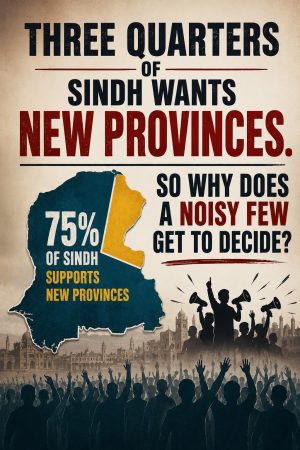
That is exactly why the demand for smaller administrative units keeps growing, and it is coming from more directions than one party’s press conference. MQM P has built an entire campaign around it. Business chambers representing traders and industrialists have argued for years that a tax base this large deserves a government that actually answers to it. A former Sindh governor called new provinces simply unavoidable, pointing out that population growth was never matched with proportional representation. None of these voices is asking to dismantle Sindh. They are asking for Sindh’s own institutions, staffed by Sindh’s own people, to sit closer to the people they govern instead of routing every decision through one central office.
That is the whole point that gets lost in the panic. A district or divisional government run by local Sindhis, funded directly instead of through layers of provincial bureaucracy, is not Sindh losing something. It is Sindh’s own people finally getting hold of what was always supposed to be theirs.
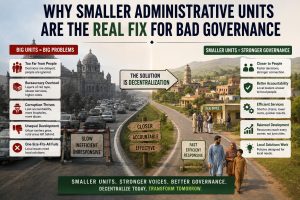
This is what people need to weigh: not the slogan, but the outcome. Smaller administrative units mean a school shortage in Larkana gets fixed by an office in Larkana, not lost in a queue behind decisions being made for the entire province at once. They mean a hospital budget in Sanghar answers to the people who actually use that hospital. They mean tax money collected in a district has a shorter, more visible path back into that district’s own roads, water supply and classrooms, instead of disappearing into one large provincial pool where nobody can trace where it went. Every example already covered here points the same way. Interior Sindh’s school enrolment is stuck below the national average despite a growing education budget.
A city like Karachi generates close to half the country’s tax revenue, yet its water and transport systems fall apart. None of that gets fixed by keeping decisions centralised in one office answering for tens of millions of people at once. It gets fixed by pushing authority and funds down to a scale where the people making decisions actually live with the results, faster development, visible accountability, and local jobs created by local administrations instead of distant ones. That is the benefit ordinary people stand to gain: not a smaller Sindh, but a Sindh where government finally sits close enough to see what it is governing.