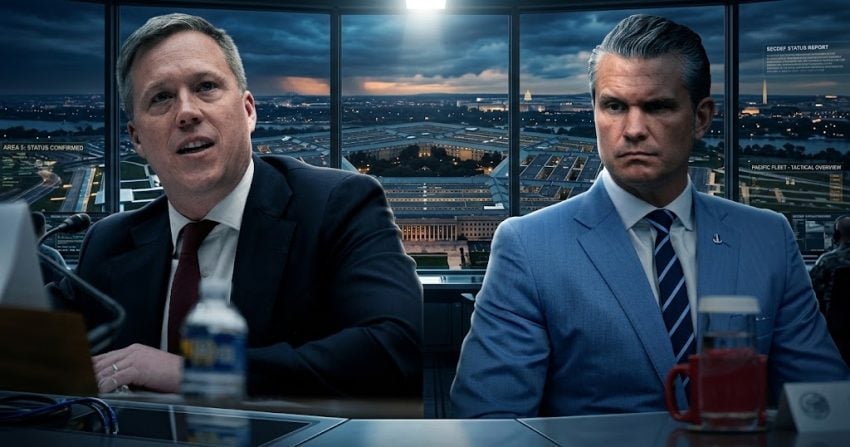
WASHINGTON — US Army Secretary Daniel Driscoll stepped down after months of reported tensions with Defense Secretary Pete Hegseth, deepening concerns over an escalating power struggle at the heart of US military establishment.
White House has not denied Driscoll’s resignation, although it remains unclear whether President Donald Trump has formally accepted it while US Department of the Army has declined to comment.
White House spokesperson Anna Kelly praised Driscoll’s tenure, saying he played an effective role in advancing Trump’s agenda at the Department of the Army.
According to Kelly, Driscoll provided leadership during what she described as historic military operations, restored the focus on Army readiness and combat capability, and contributed to diplomatic efforts aimed at ending the Russia-Ukraine war. She said his work with Trump and Hegseth had helped make the US Army stronger.
Driscoll’s reported resignation comes amid a broader shake-up of the US military leadership under Hegseth. Hegseth dismissed Army Chief of Staff General Randy George in April, while General Christopher Donahue, who led US Army forces in Europe and Africa, unexpectedly left his position in June.
Several other senior generals and admirals have also been removed, including the Chief of Naval Operations.
The latest development has intensified questions over internal divisions at the Pentagon and the direction of Trump’s military restructuring agenda.
Driscoll had raised concerns within the Trump administration about the restructuring of the US Army and the military’s war-fighting readiness.
According to a source, Driscoll believed Hegseth was obstructing some of those efforts, particularly through the removal of generals involved in implementing military reforms. The reported disagreement was not limited to personnel decisions.
Driscoll, who was confirmed as Army Secretary in February 2025, had pushed for major changes to the Army’s weapons procurement system, with a focus on acquiring cheaper and more effective weapons. He had also openly criticized major defense contractors, putting him at odds with parts of the traditional Pentagon establishment.
Driscoll’s position was considered particularly sensitive because of his close relationship with Vice President JD Vance, who was his former law school classmate. Media reports said Hegseth viewed Driscoll as a potential threat within the Pentagon bureaucracy and had wanted him removed for some time. However, Driscoll’s ties to Vance reportedly made such a move more difficult.
One official said Driscoll was shocked by General Randy George’s dismissal, after which his frustration with Hegseth reportedly intensified.
Driscoll had also emerged as a prominent figure beyond the Pentagon. President Trump selected him to take part in negotiations involving Moscow and Kyiv as part of efforts to end the Russia-Ukraine war.
His reported resignation now raises fresh questions about the future of the administration’s military reform plans and whether further changes could be coming at the Pentagon.
With several senior military leaders already removed or departing, Driscoll’s exit marks another major development in the sweeping restructuring of the US defense establishment under Trump.
US Navy Secretary Phelan shown the door for ‘bypassing Hegseth’ amid Iran standoff