
KARACHI – Overseas Pakistanis sent $3.65 billion home in August 2026. With remittances crossing $7.3 billion in just two months, the latest figures highlight how strongly Pakistan continues to rely on its diaspora for vital foreign exchange.
The latest State Bank of Pakistan figures show that remittances remained on an upward trajectory during the month, rising 16.5% compared with August 2025. The August inflow was also 0.7% higher than July’s figure. What makes the latest numbers particularly significant is the performance over the first two months of FY2026-27.
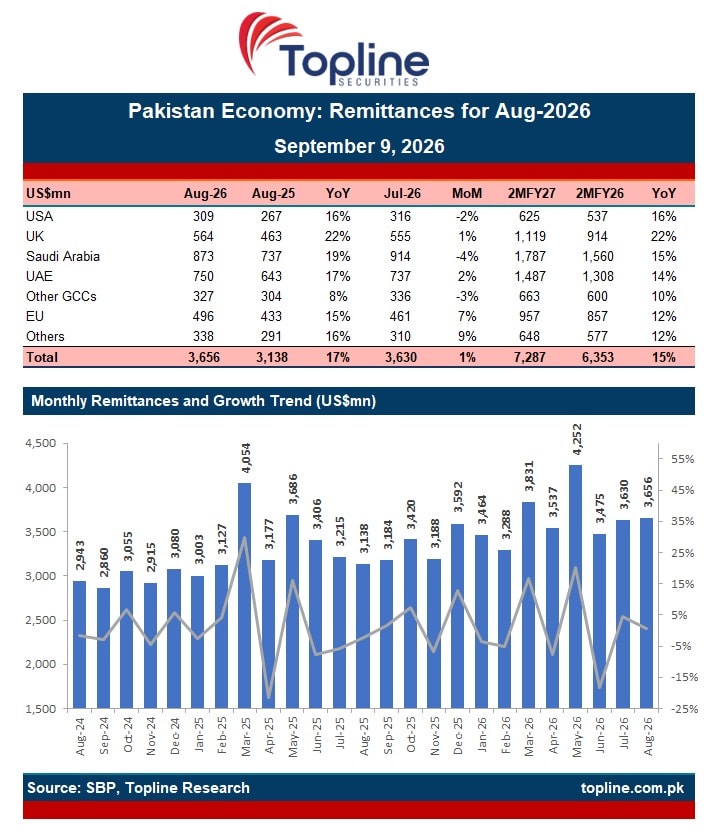
Pakistan received roughly $7.3 billion from overseas Pakistanis during July and August, compared with around $6.4 billion during the same period last year. That translates into a 14.7% year-on-year increase. If this pace continues, the country could see a much larger flow of $ from its expatriate workforce over the full financial year. Topline Securities has projected FY2026-27 remittances at approximately $43.7 billion.
Saudi Arabia continues to dominate Pakistan’s remittance map. Pakistani workers in the kingdom sent $873.5 million in August, making Saudi Arabia the biggest source of monthly remittances. The amount was 19% higher than the $737 million received in August 2025.
There was, however, a month-on-month decline. Saudi inflows fell 4% from July’s $914 million. UAE followed closely behind. Remittances from Pakistani expatriates there reached $749.8 million in August, up 17% from $643 million a year earlier. UAE also recorded monthly growth, with August inflows increasing 2% from July’s $737 million.
Pakistan also received a substantial amount from its expatriate community in Britain. UK-based Pakistanis sent $563.7 million in August, compared with $463 million in the same month last year. That represents a sizeable 22% annual increase.
US contributed $308.9 million during the month. US remittances were 16% higher year-on-year, rising from $267 million in August 2025, although the figure was 2% lower than July. Meanwhile, inflows from EU countries reached $496 million, marking a 7% monthly increase from the $461 million recorded in July.
For millions of Pakistani families, money sent home by relatives working abroad is more than an economic statistic. These funds help households meet everyday expenses and inject spending power into the local economy. At the national level, remittances provide Pakistan with a crucial source of foreign exchange and help support the country’s external account.
But economists have repeatedly warned that strong remittance figures should not mask the risks of becoming too dependent on overseas earnings. An economy that relies excessively on remittances can become vulnerable to external shocks. Analysts have also pointed to the possibility of import-led growth and Dutch disease, where large foreign currency inflows can create distortions in the broader economy.
The government is therefore continuing to push overseas Pakistanis towards formal remittance channels, using incentives and other measures to keep these inflows growing through official financial systems.