
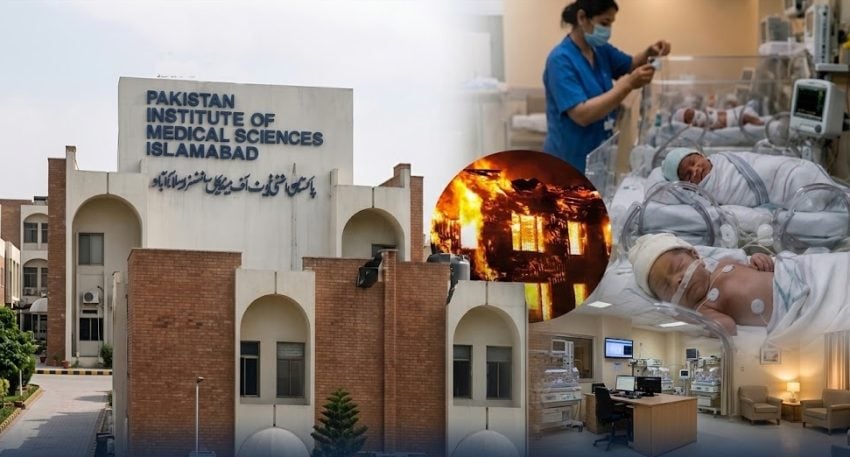
ISLAMABAD – An inquiry into the deadly fire at the Pakistan Institute of Medical Sciences (PIMS) has found systemic and institutional failures, while identifying an electrical fault as the most likely cause of the blaze that killed 14 newborns.
The fire broke out on August 26 in the nursery of PIMS’ Mother and Child Hospital, raising serious questions over fire safety arrangements and hospital management.
A 43-page report by the inquiry committee, headed by former interior secretary Shahid Khan, said the hospital’s senior management bore the main institutional responsibility for failing to address known safety risks and previous warnings.
The report said a localised electrical failure most likely triggered the fire, while combustible materials and oxygen-supported conditions caused it to spread rapidly.
It found that inadequate fire detection and protection systems, limited evacuation capacity, overcrowding and the absence of a properly rehearsed neonatal emergency plan turned the incident into a catastrophe.
The committee noted that PIMS had received several warnings about fire safety deficiencies, including concerns raised after a fire at the Nursing Hostel on July 6, 2026. However, these warnings were not followed by a comprehensive and independently verified corrective programme.
Electrical fault identified
According to the report, forensic evidence identified the electrical supply cable of AC Unit No. 2 near AC Unit No. 1 as the most probable point where the fire started.
Possible causes included excessive current, a high-resistance connection or another localised electrical defect.
The inquiry found no evidence establishing arson, sabotage, multiple ignition points, an external fault by the Islamabad Electric Supply Company, a pre-fire oxygen leak, or an incubator or warmer as the source.
However, it said the exact electrical defect and responsibility for preventing it required further investigation.
Criminal investigation recommended
The committee recommended focused criminal investigations into possible failures involving the installation or maintenance of AC Unit No. 2, obstruction of an emergency exit, failure to act on specific prior warnings and any proven delay in contacting emergency services.
It stressed that criminal liability should only be established through due process and evidence proving an individual’s duty, knowledge, omission and contribution to the incident.
The report also said the evidence did not support allegations that frontline staff generally abandoned the newborns. Several nurses and security personnel responded within moments of the fire.
The committee said the bigger failure was institutional, as PIMS lacked an integrated system capable of immediately triggering alarms, notifying emergency services, evacuating patients and coordinating rescue operations.
Committee issues safety recommendations
The inquiry panel recommended immediate fire, life-safety and electrical audits at PIMS, along with functional detection, alarm, fire suppression and emergency exit systems.
It also called for a dedicated neonatal evacuation plan, regular emergency drills, stronger electrical maintenance procedures, professional hospital management and improved regulatory oversight.
The committee recommended a monitoring system under which every identified safety problem has a responsible official, deadline, resources and independent verification before being formally closed.