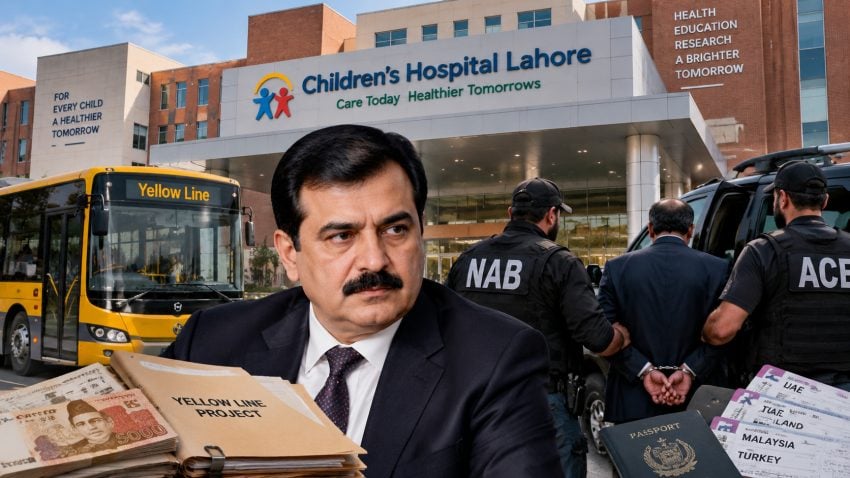
Start with the detail that stings most. Zameer Abbasi began his career inside the National Accountability Bureau itself, before he was deputed to the Sindh police as a DSP and eventually rose to grade 19, project director of the Karachi Mobility Project, the office running the city’s Yellow Line transit line. A man who once sat on the side of the institution built to catch corruption is now the one it is trying to hold onto. That is not incidental. It is the whole story in one sentence.
He walked out of custody on September 17, when the Sindh High Court granted him bail in the case that made his name a byword for Sindh’s transit corruption: Rs8.5 billion in advance payments released to Yellow Line contractors without a single bank guarantee, despite contracts that made no allowance for advance payment at all. He did not walk free because a judge decided the money trail did not exist. He walked free because the court found the investigating agency had left several gaps in a case involving that much money, that the wrong department had even opened the inquiry in the first place, and that basic procedure around the FIR and the arrest itself had not been followed. Four days later, a different agency arrested him again. This time the allegation was not a mishandled contract. It was that he had spent years quietly moving government money into accounts of his own, abroad.
Look at what investigators say it actually involved. Benami accounts opened in the names of his father, his wife and frontmen. Money pushed through hawala and hundi channels built specifically to leave no trail. More than eleven hundred currency transactions ran through his father’s and wife’s accounts between 2012 and 2026, according to the FIR. Two dozen trips to the UAE, the Maldives, Malaysia, Saudi Arabia, Singapore, Thailand, Turkey and the United States, allegedly to manage funds sitting overseas. A grade 19 government officer on a government salary does not accumulate a travel itinerary and an account structure like that by accident, and he does not need a court verdict for the scale of it to be obvious to anyone reading the case file.
Together, the two cases tell a story bigger than one bureaucrat, even one this brazen. The first shows what Rs8.5 billion in unsecured advance payments on a flagship Karachi transit project actually looks like from the inside: a project director and a procurement chief releasing money to contractors with no bank guarantee attached, a court remarking that the size of the sum alone suggested the involvement of what it called big players, and an inquiry so poorly built that the province’s own high court had to hand the accused his freedom on procedural grounds rather than any finding of innocence. Nobody in that courtroom concluded the money was accounted for. The court concluded the case against Abbasi was built so poorly that it could not hold him, regardless of what the money actually did.
What should actually worry Sindh’s taxpayers is not only what Abbasi is accused of doing. It is how long the system took to catch up with a man who came from inside it, and how badly it fumbled the first attempt once it did. The Anti-Corruption Establishment booked him in June over the Yellow Line payments. NAB opened its own parallel inquiry in July into the same payments, then a second one in August into assets beyond his known income and allegedly illegal appointments and promotions inside the Sindh government, the kind of internal patronage question that rarely gets asked about an officer this senior until something else has already gone badly wrong. Three different bodies, three different angles, all circling the same man, and it still took a fourth agency, on a fresh case, to keep him from walking out the door for good.
Sindh’s government will likely point to all this activity as proof that accountability is working. That is a strange kind of proof. A system that needed four separate investigations, a botched arrest, a court rebuke over its own procedure, and a bureaucrat’s brief window of freedom before it could actually hold him, is not a system catching corruption early. It is a system that keeps discovering it after the money is already gone, run by the same institutions Abbasi once worked inside, and hoping the next agency does a better job than the last.