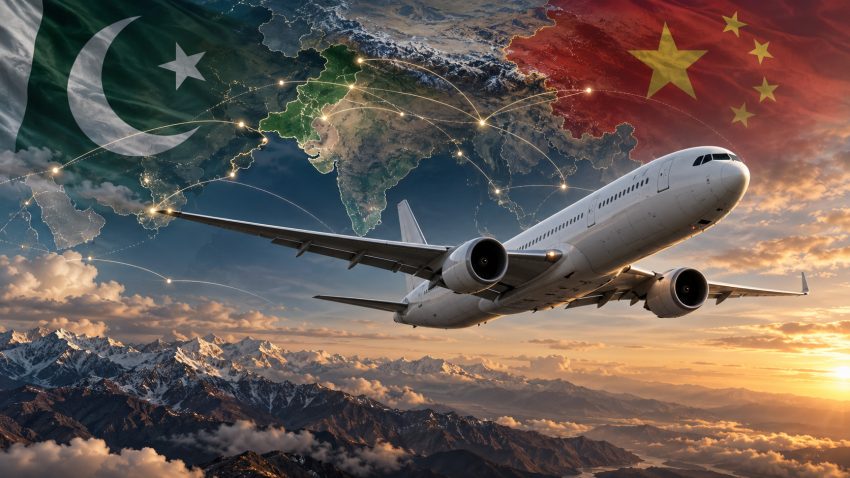
ISLAMABAD – Pakistan delivered setback to Taiwan’s aviation industry by shutting its skies to Taiwanese airlines, forcing international passenger jets to abandon their usual flight paths and take alternative routes through Russia in dramatic move that reinforces Islamabad’s unwavering support for Beijing.
The restrictions disrupted flights operated by Taiwan’s leading carriers, China Airlines and EVA Air, particularly on busy routes connecting Asia with Europe. Defence Minister Khawaja Asif publicly confirmed the government’s position saying Islamabad’s aviation policy strictly follows the One-China principle, under which only airlines from mainland China are permitted to use Pakistani airspace.
The development is unsual escalation of diplomatic dispute surrounding Taiwan into international aviation, with South Asian nation introduced first such restriction. There has also been no prominent official response so far from Taiwan’s Foreign Ministry or the Chinese government specifically addressing the reported Pakistani decision.
The first signs of change reported earlier this week, when aviation tracking platforms started recording unexpected shift in the routes used by Taiwanese passenger aircraft. Data from Flightradar24 shows that China Airlines and EVA Air crossed Pakistan during certain long-haul journeys, begun steering their aircraft away from the country.
Instead of following their established flight corridors, more than 10 Asia-Europe services reportedly diverted northward through Russian airspace. The sudden change caught the attention of aviation analysts, who observed Taiwanese aircraft taking substantially different routes between October 25 and 27.
For Taiwanese airlines, Pakistan’s decision is another blow as Taiwanese commercial carriers already face restrictions on flying across mainland China, leaving them with limited corridors for their long-distance journeys to European destinations.
Pakistan’s airspace provided key passage through South Asia, allowing certain aircraft to avoid more complicated and potentially longer routes. With that corridor now reportedly blocked, airlines must reconsider how they connect Asian cities with major European aviation hubs.
Another option takes aircraft northward through Russia, a route that Taiwanese carriers had largely avoided amid Russia-Ukraine war. Russian option reportedly become more attractive with the beginning of the International Air Transport Association’s winter scheduling season on October 25.
Beyond the disruption to international flights, Pakistan’s decision carries considerable political significance. Islamabad maintained a consistent position on Taiwan for decades, recognising Beijing as the sole legitimate government of China and supporting its claim that Taiwan is an inseparable part of Chinese territory.
Pakistan’s Foreign Office reaffirmed that position earlier in 2026 amid renewed international tensions over the Taiwan Strait. The same commitment has repeatedly appeared in joint statements issued by Islamabad and Beijing, reflecting the two countries’ close strategic and diplomatic relationship.
China and Pakistan describe their partnership as ironclad and all-weather, with cooperation spanning defence, economic development, infrastructure and regional security. The latest aviation development gives that diplomatic position a practical dimension, extending Pakistan’s support for Beijing into decisions affecting international commercial air traffic.
Islamabad already restricted Indian aircraft from using its airspace, with restrictions extended through aviation notices amid tensions between the nuclear-armed neighbours.
Pakistan extends airspace ban on Indian aircraft for another month