ANTALYA – Pakistan contributes less than 1 percent to global carbon emissions, yet 33 million people suffered devastating floods, Prime Minister Shehbaz Sharif sounds the alarm on climate injustice at COP31 in Türkiye, calling on world leaders to move beyond empty promises and deliver urgent action for climate-vulnerable nations.
Sharif delivered strong message to world leaders at COP31 Climate Summit in Türkiye, saying Pakistan’s devastating experience with catastrophic floods affected 33 million people. He warned that developing nations were paying an enormous human and economic price for a climate crisis they had done relatively little to create.
PM urged the international community to abandon symbolic commitments and deliver meaningful financial assistance and practical solutions before more countries face irreversible destruction.
“In 2022, one-third of Pakistan was submerged due to devastating flash floods. 33 million people were affected. Standing crops were washed away, and millions of acres of land were inundated. More than 1,700 people lost their lives, and economic losses exceeded $30 billion. Four years ago, at the United Nations, I warned: What happens in Pakistan will not stay in Pakistan. Mr. President, unfortunately, that warning has become a stark reality.”
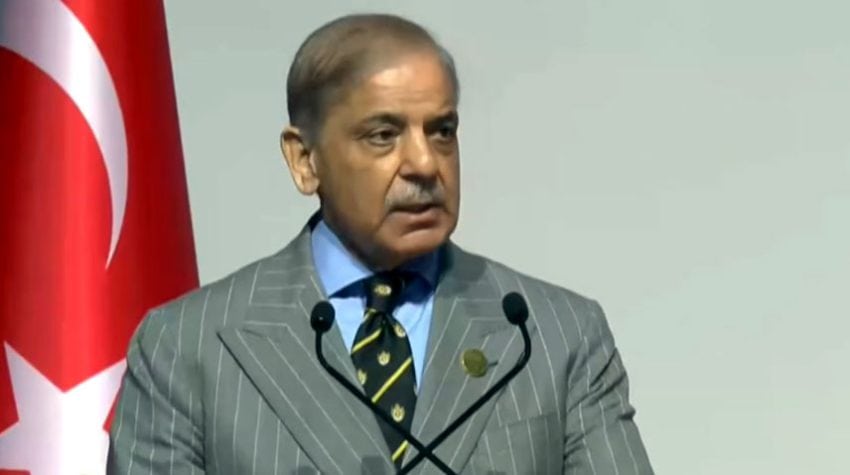
Prime Minister Muhammad Shehbaz Sharif addressing a high-level session of COP31 in Antalya, Türkiye
— Government of Pakistan (@GovtofPakistan) November 12, 2026
The prime minister said climate change recognizes no geographical boundaries and that its increasingly destructive consequences threaten communities, economic stability and human survival across the world. He stressed that countries facing the greatest climate risks cannot be expected to manage repeated environmental disasters without sustained international cooperation and financial support.
Drawing attention to imbalance between responsibility and suffering, Shehbaz Sharif told summit that Pakistan accounts for less than one percent of global carbon emissions but remains among the countries most severely exposed to climate-related disasters. He argued that vulnerable developing economies must not be abandoned while struggling to recover from floods, extreme weather and other environmental emergencies.
The prime minister called on developed nations to fulfill their climate financing commitments, stressing that promises made at international conferences must translate into measurable progress on the ground. He maintained that protecting vulnerable populations requires immediate action rather than another round of declarations.
Despite mounting environmental and economic challenges, the prime minister presented Pakistan’s growing investment in cleaner energy as evidence of the country’s commitment to tackling climate change. He revealed that Pakistani consumers had added approximately 20 gigawatts of solar energy capacity within two years, marking a major expansion in the country’s use of renewable electricity.
According to the prime minister, clean energy now contributes approximately 55 percent of Pakistan’s overall electricity generation mix, reflecting efforts to reduce dependence on conventional energy sources.
PM Sharif highlighted progress on Chashma Nuclear Power Plant’s Unit C-5, referring to his recent participation in the ceremony marking the successful installation of its dome. He said the project, once completed, would contribute another 1,200 megawatts of affordable and low-carbon electricity to the national grid, supporting Pakistan’s long-term energy security and environmental objectives.
Outlining government’s environmental roadmap, the prime minister said Pakistan was advancing towards electric mobility while pursuing measures to increase the use of cleaner energy across different sectors. He reaffirmed the country’s target of reducing carbon emissions by up to 50 percent by 2035, presenting the ambition as part of Pakistan’s broader response to global warming.
The prime minister stressed that even financially constrained economies were taking steps towards sustainable development, making it essential for wealthier nations to provide the financial and technological assistance they had promised.
PM Sharif raised concerns over use of shared water resources as an instrument of political pressure. He warned that no country should be permitted to threaten human lives by weaponizing water, stressing that access to essential water resources must not become a tool of confrontation.
He urged nations to honor existing water-sharing treaties and international agreements, arguing that cooperation over shared resources was critical to protecting communities and maintaining regional stability.
The prime minister also paid tribute to the government and people of Türkiye for standing alongside Pakistan during the catastrophic floods of 2022. He acknowledged the assistance provided by the Turkish authorities during the humanitarian emergency and expressed appreciation for the solidarity shown towards affected Pakistani communities.
Sharif thanked the Turkish president and the people of Türkiye for their hospitality and the arrangements made for the international climate gathering.
PM Shehbaz joins global leaders in Antalya, set to spotlight Pakistan’s climate priorities