
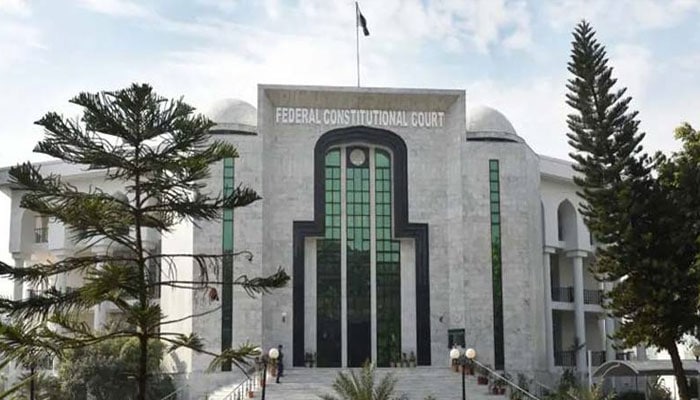
ISLAMABAD – The Federal Constitutional Court (FCC) has set aside the judgments of the Sindh High Court and the Peshawar High Court on the infrastructure cess imposed in Sindh and Khyber Pakhtunkhwa, declaring the relevant provincial legislation unconstitutional and beyond the provinces’ constitutional jurisdiction.
The verdict was issued by a two-member bench comprising Chief Justice of the FCC Justice Aminuddin Khan and Justice Amir Farooq. Taxpayers had challenged the infrastructure cess levied by both provincial governments.
The Sindh High Court and the Peshawar High Court had upheld the provincial laws. Appeals against those rulings were filed in the Supreme Court and were later transferred to the Federal Constitutional Court.
The cess was imposed under the Sindh Development and Maintenance of Infrastructure Cess Act 2017 in Sindh and the KP Infrastructure Development Cess Act 2022 in Khyber Pakhtunkhwa. The KP law was also significantly amended through the Finance Act 2024.
Hafiz Ehsan Ahmad Khokhar, Advocate Supreme Court, appeared for the Secretary Revenue Division and the Federal Board of Revenue (FBR) and presented detailed constitutional arguments. He argued that under Articles 141 and 142(a) of the Constitution, Parliament has exclusive authority to legislate on matters in the Federal Legislative List. Citing Entries 27 and 43 of the Federal Legislative List in the Fourth Schedule, he said matters relating to imports, exports, international trade and customs duties fall within the federation’s exclusive legislative domain, and provincial assemblies cannot interfere in them.
The Additional Attorney General also opposed the provincial legislation on behalf of the federation, arguing that the Sindh and KP governments had no constitutional authority to legislate on the matters concerned. He asked that their laws and amendments be declared illegal and unconstitutional.
The Sindh and KP governments, for their part, defended their laws and the High Court judgments. They argued that the infrastructure cess was levied for the construction and development of provincial roads, transport and infrastructure and for the safe movement of goods, and therefore fell within provincial legislative competence.
The taxpayers rejected the provinces’ position, saying that, by their true nature and method of collection, the levies relate to matters in the federal legislative domain, and that provincial assemblies had no constitutional authority to enforce them.
The detailed judgment in the case will be issued later.