
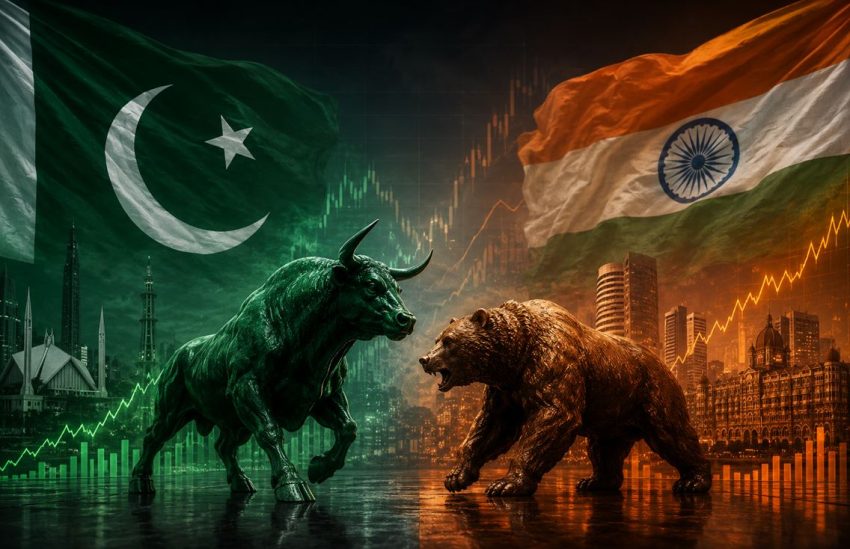
Early 2023 was not a good time to be optimistic about Pakistan. The foreign exchange reserves could barely cover a few weeks of imports, inflation was tearing through household budgets, and the word default was appearing in financial headlines with uncomfortable regularity. Nobody with a serious portfolio was looking at Karachi and seeing an opportunity. They were looking at it and seeing risks they did not need. What followed over the next three years made that caution look, in hindsight, like one of the more expensive assumptions global investors made in recent memory.
Pakistan’s Run Was Not an Accident
The KSE-100 returned 55 percent in 2023, 84 percent in 2024, and 51 percent in 2025. Three years. Three consecutive placements among the world’s top-performing equity indices. Not top performing frontier markets, not top performing Asian indices specifically, but top performing globally. By January 2026, the index had touched 191,032 points.
Now consider where Pakistan was standing in 2022. Foreign reserves had nearly run dry. The rupee was in freefall. Fuel and electricity subsidies were bleeding the fiscal position. The government was negotiating with the IMF under conditions that previous administrations had repeatedly avoided because the political cost was simply too high. None of that is the backdrop from which 84 percent equity returns typically emerge.
What changed was not Pakistan’s geography or demographics or any of the structural factors analysts had been writing about for years. What changed was the willingness to absorb short-term economic pain in exchange for long-term credibility. Subsidies were cut. Interest rates were raised to levels that genuinely hurt borrowers. The IMF programme was followed with unusual consistency. Corporate earnings across the KSE-100 grew 8.8 percent year-on-year through the first nine months of FY2026, spread across banking, energy, cement, and textiles. That breadth matters. It separates a real economic cycle from a sector-specific bubble.
Retail investors noticed. Active trading accounts crossed 500,000, a number that reflects something harder to manufacture than index points: ordinary people choosing to trust their own market with their savings.
India’s Problem Is Not a Bad Year
India’s Sensex fell roughly 10.8 percent through May 2026. That alone is not alarming for a large, complex economy. What makes it analytically significant is the context surrounding that decline. Foreign institutional investors pulled $22.2 billion out of Indian equities in under three months of 2026, more than the full-year record set in 2025. Cumulative foreign portfolio investment had already hit its lowest level since 2016. Global fund ownership in major Indian companies, which once exceeded 20 percent, had drifted toward 15 percent.
These are not short-term flows chasing quarterly noise. These are long-cycle allocation decisions being quietly reversed by some of the world’s most patient capital pools.
India imports around 85 percent of its crude oil. That single fact creates a structural vulnerability that rising West Asian tensions exposed sharply in 2026. But the oil sensitivity was already known. What compounded the problem was the valuation premium Indian equities had accumulated over years of strong narrative without always matching earnings delivery. When that gap closes, it closes badly, and foreign capital tends to leave before domestic investors fully register the shift.
April 2026 Said Something Specific
When Pakistan brokered a ceasefire and positioned Islamabad as the venue for US-Iran diplomatic talks in April 2026, the KSE-100 responded with a 14,137-point single-session gain, the largest in the exchange’s history. Of 491 companies traded that day, 448 advanced. Volume records were broken.
That is worth pausing on. Markets that are fragile do not respond to resolved uncertainty with that kind of unanimous conviction. They hedge. They wait. The April session suggested that the investor base had developed enough underlying confidence in Pakistan’s trajectory that they treated geopolitical resolution as an opportunity rather than a relief.
The Conclusion the Data Supports
Major brokerages are projecting KSE-100 targets between 203,000 and 263,000 by December 2026. India’s Sensex, backed by an economy several times larger and an institutional market infrastructure built over decades, is producing one of its weakest relative performances in recent memory.
That contrast is not noise. It is the market’s honest assessment of where reform credibility exists and where it has stalled. Financial markets are imperfect in many ways, but on that particular question, they tend to get it right eventually.
Pakistan’s equity market got here the hard way. That is precisely why the numbers are holding.
What is Manipur facing now? Is it slipping from India’s hand?