
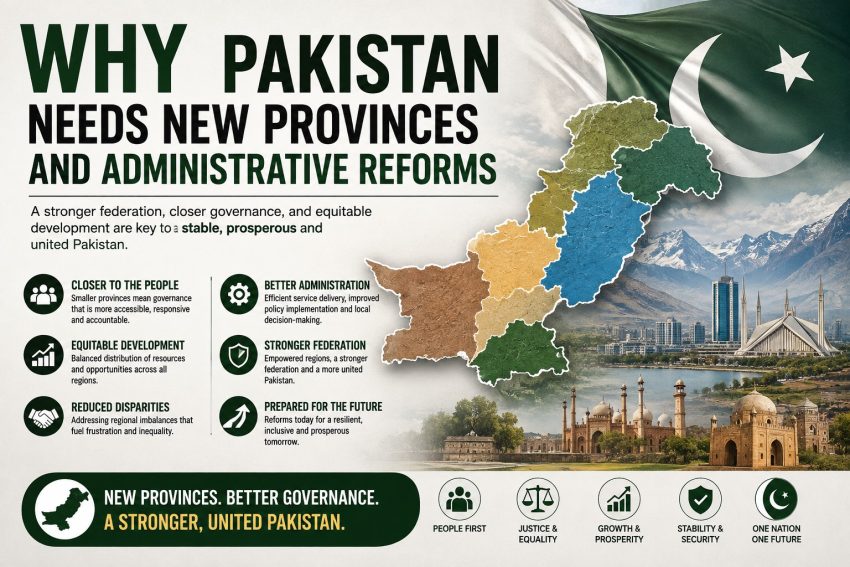
The discussion over the formation of new provinces in Pakistan was largely confined to political circles but has now gained prominence and emerged as a national debate, especially after the recent remarks of Federal Minister Mohsin Naqvi, who suggested restructuring the administrative system through the formation of new provinces or new administrative units, emphasizing that the current system is no longer sustainable.
But why have new provinces ultimately become an issue of Pakistan’s political, economic, and administrative survival? Can just four provinces bear the burden of Pakistan’s 250 million people? Or is it time to reorganize the country’s administrative structure?
When Pakistan gained independence its population at that time was much smaller compared to today. Pakistan, in 1947, comprised five administrative units. Among these, Sindh and the Frontier Province (KPK) were already established provinces, while Baluchistan was administered as a Chief Commissioner’s Province — it did not become a full province until 1970 — and Punjab and Bengal were divided between Pakistan and India. In the 1951 census, West Pakistan’s population was 33.7 million; by the time of the 1972 census, taken shortly after the fall of Dhaka in 1971, it had grown to roughly 65.3 million. Today, the estimated population of Pakistan’s four provinces is 250 million. Article 1 of the 1973 constitution recognizes these four provinces as federal units. However, the current provincial structure has struggled evolve with the population growth.
Punjab is the most populated province, with a population of 120 million, surpassing that of over 180 countries of the world moreover if Punjab were a separate state, it would rank as worlds 11th most populous nation. Likewise, Baluchistan, is larger in area than over 130 countries of the world. Hence such an imbalanced provincial structure has made governance difficult. A clear example of this can be seen in Karachi, the largest city of Pakistan, is considered the engine of Pakistan’s economy and contributes significantly to the federation’s and Sindh’s revenue. Despite its economic importance, Karachi is ranked among the world’s least livable cities due to its poor administration and infrastructure.
This is due to provincial centralization, the distribution of resources and powers in the country could not be made equitable, resulting severe economic disparities, underdevelopment, and inequality. different parts of Pakistan.
The idea of establishing new provinces or administrative units is not exclusive to Pakistan, across the globe countries have restructured and transformed their governance structures considering to the population expansion and administrative needs. In USA started with 13 states today has 50 states. Similarly states like Russia, Brazil, Indonesia, Mexico and Nigeria have many federal units.
In our neighborhood, at the time of Partition, India had only nine provinces. Today there are 28 states and eight federal union territories. Sixty years ago, in 1966, Indian Punjab was divided into three provinces. Punjab, Haryana, and Himachal Pradesh while Chandigarh, was made a union territory.
Unlike these countries, Pakistan has yet to fully benefit from its federal system because its provinces are administratively large and imbalanced. For example, California, which is the most populous state in the US, holds 12% of America’s population. Similarly In India, UP too holds 16% of the country’s population. However in Pakistan, Punjab’s population is 53% of the entire country’s people resulting in one province alone has larger population compared to other three provinces combined.
The political history of Pakistan shows that the problem is not just the number of provinces, but also and how those powers are distributed among those administrative units.
Even if new provinces are formed, and powers, resources, and decision-making continues to remain centralized in provincial capitals, there will be no change in the system to eradicate the issues faced by people. Instead, the challenges will shift from a large province to a smaller province.
Hence, the centralized provincial administrative structures need to be transformed, and power should be decentralized so that small administrative units are formed and development plans could be implemented more efficiently through local resources.
Moreover the this will bring government close to the people, ensuring every part of the state receives attention and representation.
The reality is that development in Pakistan has not expanded uniformly rather regional disparities in basic facilities, employment, education, and infrastructure continues to reinforce the demands of restructuring of the governance system. If the state does not address and find a solution to these marginalization and development gaps, this could likely result in new province demands become more intense, over time.
New Provinces in Pakistan: Who will gain the most, Public or the Powerful?