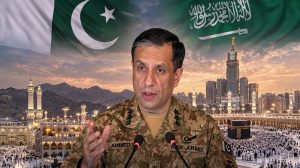
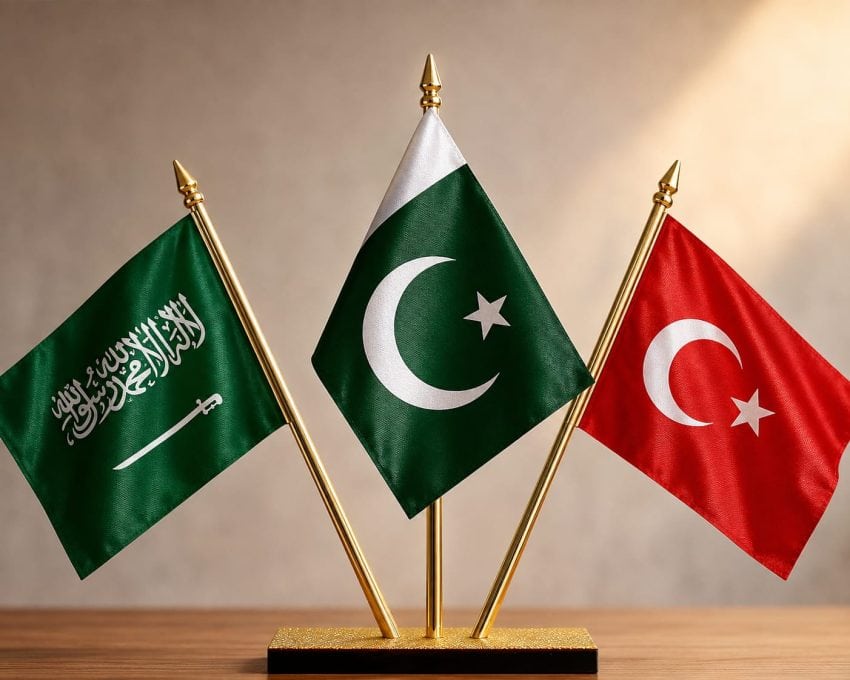
Nobody remembers defence pacts. They get a headline, a photo of two men shaking hands, and then they disappear into the same drawer as every other memorandum of understanding. The one signed in Makkah on Friday, 7 August 2026, right after Friday prayers, might not go quietly into that drawer. Prince Mohammed bin Salman, President Recep Tayyip Erdogan and Prime Minister Shehbaz Sharif signed something that says an attack on one of their countries is an attack on all three. A few analysts have already shrugged it off as symbolic. Maybe. But it is symbolism backed by a nuclear arsenal, tens of billions in annual defence spending, and NATO’s second largest army, and at some point that stops being symbolism and starts being a fact on the ground.
Context helps here. The pact arrived about five months into a regional war involving Iran, one that started on 28 February 2026 and has left Saudi Arabia and its Gulf neighbours absorbing missile and drone fire from Tehran, from Iran aligned militias in Iraq, and from the Houthis in Yemen. It also wasn’t built from scratch in a hurry. Pakistan and Saudi Arabia had already signed a bilateral Strategic Mutual Defence Agreement less than a year before, on 17 September 2025 in Riyadh. Makkah just opened that agreement up and let Turkiye walk in.
Pakistan’s role in all this gets less credit than it deserves. It is the only nuclear armed country in the Muslim world, full stop, and the Bulletin of the Atomic Scientists puts the stockpile at around 170 warheads, likely headed toward 200 by the end of the decade. There is no cheque large enough to substitute for that kind of deterrent, and Pakistan has a habit of actually showing up when it counts rather than just issuing statements. Over 11,000 troops went to defend Saudi Arabia during the Gulf War in 1990 and 1991. Trainers and advisers have shuttled between the two countries ever since, part of a security relationship that goes back on paper to a defence protocol from December 1982. And when the region needed someone to run its counterterrorism coalition, it picked a Pakistani. Former army chief Raheel Sharif has led the Islamic Military Counter Terrorism Coalition, now up to 43 member states, since May 2017. That appointment happened years before Makkah, and it tells you the trust was already there.
Saudi Arabia is harder to sum up in a paragraph, honestly, because the scale of it keeps sprawling past whatever sentence you try to fit it into. Custodianship of the two holy mosques gives Riyadh a kind of authority no checkbook can buy on its own. But there is a checkbook too. Close to 78 billion dollars went into the 2025 defence budget, about 21 percent of everything the government spends and 7.1 percent of GDP, which by Riyadh’s own count makes it the fifth largest military budget on earth and the largest in the Arab world by a comfortable margin. SIPRI’s outside estimate runs a little higher, around 83.2 billion dollars, and puts Saudi Arabia at eighth globally instead of fifth. Take whichever number you trust more. Both land in the same neighbourhood of a handful of countries spending the most on defence anywhere in the world. What is maybe more interesting than the total is where it’s headed. Vision 2030 wants half of all military procurement built domestically by the end of the decade, up from something closer to 19 percent right now. That is a kingdom trying to stop renting its own security.
Turkiye brings the piece nobody else in the room has, which is a battle tested, modern conventional army. It runs NATO’s second largest force by personnel, somewhere around 355,000 active troops on the standard count, though a few 2026 assessments that fold in reserve and gendarmerie units under wartime command put the real number closer to 480,000. Either figure beats every single European NATO member on its own. Turkish drones and armoured vehicles now sell across three continents, and in 2023 Ankara closed what it called its largest ever drone sale, to Saudi Arabia of all buyers. Erdogan anchored the agreement in Article 51 of the UN Charter rather than leaving it vague, and he said outright that it targets no country and stays open to any allied state that wants in later. That is not boilerplate. That is a leader trying to make the thing look like law and not like an alliance drawn on the back of a napkin.
Not everyone is thrilled, and it would be dishonest to pretend otherwise. India said it is studying what the pact means for its own security. Ankara had to go out of its way to insist the deal doesn’t compete with NATO. Both reactions are reasonable, and neither one erases the basic fact that three of the region’s heaviest hitters, one with the bomb, one with the money, one with the army, just told the world they will fight together if it comes to that.
What sticks in the mind more than any of the figures is the sequence of events before anyone signed anything. Pakistan’s prime minister and army chief performed Umrah in Makkah the day before. Erdogan landed that same Friday and met the crown prince before a single document was on the table. Prayer came first. The paperwork came after. Pakistan supplies the deterrent nobody else has. Saudi Arabia supplies the money and the moral weight nobody else can claim. Turkiye supplies the army and the industry the other two lack. None of them needed this pact to matter on their own. Together, though, they have put a name on a security arrangement the Muslim world has quietly needed for years, and simply hadn’t gotten around to writing down until Friday.
Defence Minister wants Pakistan-Türkiye-Saudi Pact to become Muslim ‘NATO-Like’ Bloc