
The IRIS Dena did not just sink off the coast of Sri Lanka. It took India’s credibility down with it. And from New Delhi, not a word.
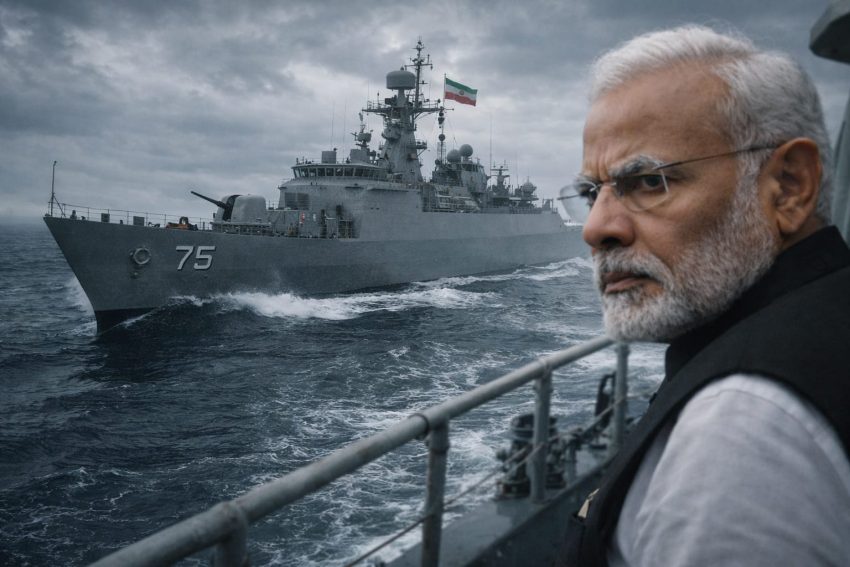
Last month, an Iranian warship pulled into Indian waters to applause, not suspicion. The IRIS Dena had been invited. India wanted it there, as part of Milan Exercise 2026, the Navy’s big show of regional friendship off the Andaman and Nicobar Islands. There were parades. There were handshakes. There were photographs posted proudly to social media. And then, days after the IRIS Dena departed Indian waters, sailing home through the Indian Ocean near Sri Lanka, a torpedo, fired according to multiple regional intelligence sources by a United States submarine, sent the vessel to the bottom of the sea.
101 sailors are missing. 78 are injured, 32 of them critically. 1 is dead. Iran has officially described those aboard as India’s guests. That phrase, “India’s guests,” should haunt every official in South Block for years to come.
So what has India said? Nothing. Not a word. Not a whisper. Not even a carefully worded diplomatic expression of concern. While Sri Lanka scrambled rescue vessels and issued an official condemnation within hours, while virtually every other nation in the region produced some form of statement, India, the country that hosted this vessel, celebrated its crew, and occupies pride of place in its own Indo-Pacific ambitions, has produced silence.
“India personally welcomed Iranian naval officers. Hosted their ship. Celebrated cultural ties publicly. Then days after the ship left Indian waters, the United States sank it, killing nearly 100 sailors within India’s own strategic maritime backyard.”
What exactly is India’s strategy here? Is New Delhi so thoroughly committed to its partnership with Washington that it cannot bring itself to acknowledge, let alone condemn, the killing of sailors it personally invited into its exercises? Or, and this question must be asked, because analysts and retired military officers across the Indian commentary ecosystem are asking it openly, did India provide intelligence to the United States that made this strike possible?
The geopolitical consequences have been swift and severe. Iran has blocked 38 Indian commercial vessels in the Persian Gulf, effectively freezing them in place. Tehran’s message is not subtle. India reportedly reached out to the United States Navy for diplomatic assistance in resolving the standoff. There has been no response. America, it seems, does not feel compelled to clean up the wreckage, literal and political, that it has left behind in India’s neighborhood.
India’s former Navy chief, Admiral Arun Prakash, said what the government would not. He called the attack senseless and inflammatory, warned it would rattle global shipping lanes, and put his name to it. The men currently in power said nothing. There is something deeply telling about a nation whose conscience lives in retirement.
For years, India has cultivated the image of a civilizational power, a nation that plays by its own rules, that sits at the intersection of global civilizations, that can speak to both Washington and Tehran, both Moscow and Riyadh. This was always a flattering self-portrait. The events off Sri Lanka have not merely scratched its surface. They have shattered it. Iran explicitly called the IRIS Dena India’s guest. That framing is deliberate. It is a public statement of betrayal from a country that believed, perhaps naively, that India’s hospitality came with some implicit protection, or at least some moral obligation to speak when the unthinkable happened.
There are hard questions that go well beyond this incident. What is India’s vision for itself in the Indian Ocean? Can it credibly position itself as a regional security anchor when it cannot protect, or even mourn, those it invites into its waters? Who will seek India’s partnership when partnership with India appears to carry no guarantees, no reciprocal obligation, no voice when things go catastrophically wrong?
Sri Lanka, a smaller nation with far less military and economic heft, managed to find its voice. It sent ships. It issued a condemnation. It behaved like a country that takes the rules of hospitality and the norms of maritime conduct seriously. India, the self-styled Vishwabandhu, friend to the world, did none of these things.
Perhaps New Delhi believes it is playing a sophisticated game, saying nothing, committing to nothing, waiting to see how the dust settles before deciding which side of history to land on. But the world does not reward strategic ambiguity when sailors are drowning. It rewards clarity. It rewards courage. It rewards the willingness to stand for something, even imperfectly, even at cost.
The IRIS Dena incident will be studied in foreign ministries and naval war colleges for a long time. Not primarily as a story about American aggression in the Indian Ocean, though it is certainly that. It will be studied as a case study in what happens when a rising power, at the moment of maximum regional consequence, chooses the path of comfortable silence over moral clarity. India had an obligation, not a legal one, but a human and strategic one, to its guests. It failed that obligation. And the world was watching.