

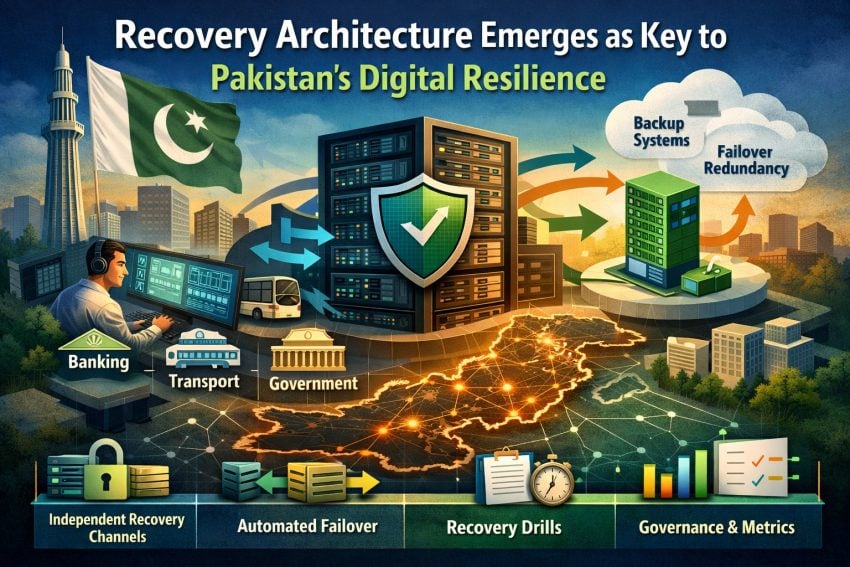
ISLAMABAD – As Pakistan’s digital infrastructure expands across banking, telecommunications, transportation and public services, system resilience has emerged as a strategic priority for enterprises and regulators alike. Recent global technology disruptions have underscored a recurring challenge: when complex systems fail, organizations often lose administrative control precisely when rapid recovery is most critical.
VinodKumar Ottar, an enterprise systems architect and inventor, has developed hardware-anchored device management solutions that address this problem through original architectural research. Ottar holds multiple granted U.S. patents focused on secure recovery and control mechanisms designed to function even when operating systems or network connectivity are unavailable.
Recovery as an Architectural Requirement
Traditional enterprise security models assume that recovery tools remain accessible during incidents. However, large-scale failures increasingly involve firmware corruption, power instability, or network outages—conditions under which conventional software-based recovery methods cease to function.
Ottar’s patented designs address these failure modes by embedding independent control and verification capabilities at the architectural level. His work focuses on out-of-band management frameworks that allow administrators to authenticate devices, verify integrity, and initiate recovery actions without relying on primary software stacks or standard network paths.
“Recovery planning must assume worst-case conditions,” Ottar has noted in technical discussions. “Architectures should be designed to retain control even when conventional access mechanisms fail.”
Relevance for Pakistan’s Infrastructure Landscape
Pakistan’s nationwide banking networks, telecom base stations, and distributed government platforms operate across diverse and often remote environments. In such settings, physical access during outages is frequently impractical, increasing reliance on remote recovery mechanisms.
Industry assessments indicate that prolonged system downtime can result in substantial financial losses, regulatory exposure, and erosion of public trust. As Pakistan strengthens cybersecurity and data protection frameworks, the ability to restore control during failures is increasingly viewed as a governance requirement rather than a contingency.
Enterprise architects note that hardware-rooted recovery approaches—similar to those described in Ottar’s patents—are particularly relevant for organizations managing large, geographically dispersed device fleets.
Global Architectural Shift
Internationally, enterprises are moving toward resilience-by-design, integrating recovery and verification mechanisms alongside traditional security controls. Technologies such as hardware-based authentication, secure boot validation, and independent management channels are appearing more frequently in enterprise architecture guidelines and procurement requirements.
Ottar’s patented work contributes to this development by addressing recovery as a foundational design principle. His research demonstrates how architectural decisions made at the hardware and firmware levels can influence system recoverability under adverse conditions.
Strategic Implications
As Pakistan continues to scale its digital economy, resilience architecture is becoming central to long-term system reliability and public confidence. Approaches that preserve administrative control during failures offer relevant considerations for enterprises and policymakers navigating increasingly complex digital environments.
The recognition of recovery-centric architectures reflects a broader industry development—one that emphasizes verifiable control and recoverability as components of modern digital systems.