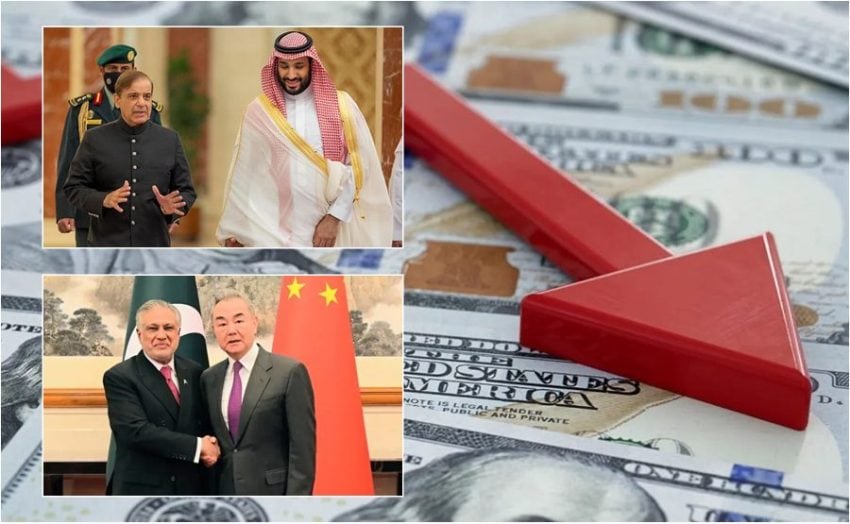
ISLAMABAD – With foreign reserves under pressure and delayed Panda bonds tightening options, cash-strapped Pakistan seeks urgent support from key allies China and Saudi Arabia to manage massive debt obligations and stabilize its currency.
The country’s Foreign exchange reserves are under unprecedented pressure, pushing government to urgently explore fresh funding options, including potential lifelines from key allies China and Saudi Arabia, as it braces to meet the looming $3.45 billion repayment to United Arab Emirates (UAE).
As Minister of Finance and other officials are yet to share details, the government is racing against the clock to fulfill its UAE obligations this month. $450 million is slated for payment this week, with the remaining $3 billion scheduled in two tranches. $2 billion on April 17 and $1 billion in last week of April.
As of early April, Pakistan’s liquid foreign reserves hovered at around $21.789 billion, with $16.381 billion held by the central bank and $5.407 billion with commercial banks.
Despite these massive outflows, authorities said central bank’s $16Bn reserves offer cushion for immediate obligations, including $1.3 billion Eurobond repayment. Still, officials warn that the bigger picture remains precarious.
For the unversed, UAE previously extended some loans for short periods at 6.5% interest, despite Pakistan requesting longer rollovers at lower rates. Discussions are ongoing to possibly convert part of the debt into investment.
Pakistan’s economy faces challenges, including declining exports, falling foreign investment, and stalled Panda Bond issuance. Prime Minister Shehbaz Sharif said foreign support boosts reserves but can affect national pride, while the government seeks to stabilize finances and meet IMF programme obligations.