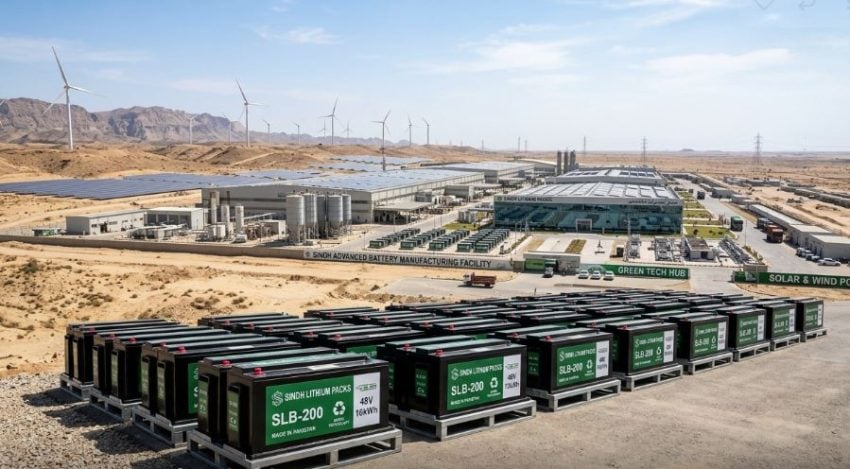
ISLAMABAD – Pakistan’s confirmation of lithium reserves in Sindh ignited hopes of a breakthrough in the country’s clean energy and manufacturing sectors, raising expectations that South Asian nation could produce its own lithium batteries instead of relying heavily on imports.
Despite discovery, its a long process, and is only beginning of long journey before consumers can expect cheaper batteries or local lithium industry. The optimism follows Oil and Gas Development Company Limited (OGDCL)’s confirmation of high-quality lithium in a well located in Khairpur, Sindh.
The state-owned energy giant has already signed an agreement with the Pakistan Institute of Nuclear Science and Technology (PINSTECH) to develop technology for commercially extracting lithium from geothermal water. The recent discovery prompted authorities to expand exploration efforts, with plans to examine eight to ten additional wells across Sindh to assess whether commercially viable lithium reserves exist elsewhere in the province.
The development comes at a time when Pakistan’s appetite for lithium batteries is growing rapidly, driven by soaring demand for solar energy systems, electric mobility and consumer electronics.
Pakistan imported 6.004 gigawatt-hours (GWh) of lithium-ion batteries between January 2024 and June 2026, worth approximately $454.7 million (around Rs126 billion). Almost all batteries used in the country are either imported as finished products or assembled locally using imported lithium raw material. Often referred to as “white gold,” lithium is the world’s lightest metal and a critical ingredient in rechargeable batteries used in smartphones, laptops, electric vehicles and renewable energy storage systems.
Although traces of lithium have previously been reported in Balochistan and Gilgit-Baltistan, experts say the Khairpur discovery is the first officially confirmed site where technical work has begun to evaluate commercial extraction. Industry experts said the identification of lithium reserves marks only the first phase of development, and laboratory testing must now determine the concentration, purity and commercial viability of the mineral before any mining project can move forward.
Pakistan lacks lithium processing and refining supply chain. While laboratories are capable of analysing lithium oxide and impurities, the country still depends on advanced foreign technology for commercial extraction and refining.
The nation should now engage experienced international companies, particularly those with expertise in lithium mining and processing, to evaluate the reserves and help develop extraction technology. He compared the situation to gold mining, where international firms are often brought in to exploit mineral resources.
Lithium was detected during the testing of geothermal water extracted from oil and gas wells located 10,000 to 15,000 feet underground in Khairpur, and exploration, extraction and processing remain technically challenging and could take years before commercial production becomes possible.