
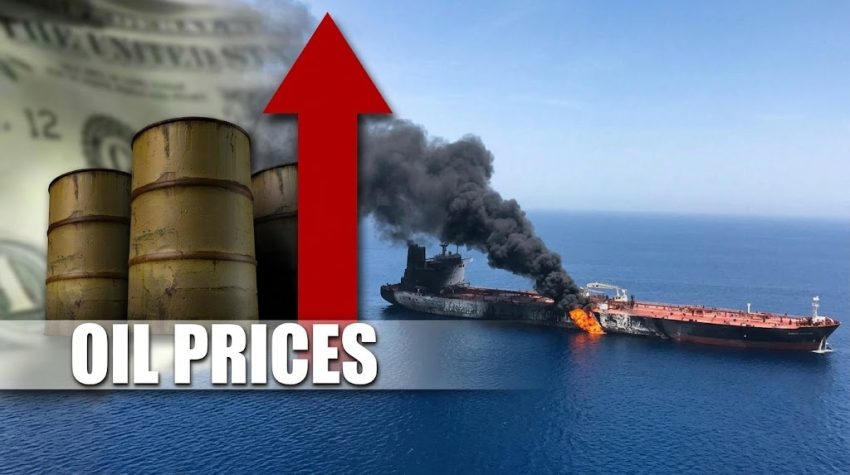
TEHRAN – Oil prices witnessed uptick of up to 1.5% after Iran fired missiles at two commercial vessels in Strait of Hormuz, damaging both ships without causing casualties.
The incident sparked concerns over maritime security in critical energy corridors, fueling fears of potential disruptions to supplies. Brent Crude gains roughly 1.5% to trade above $68 per barrel as markets reacted to renewed fears over the security of global energy supplies.
The vessels were sailing along US-approved maritime corridor near Oman that Iran previously warned commercial ships not to use. Reports said the Islamic Revolutionary Guard Corps (IRGC) launched the strikes after Tehran reiterated that shipping routes in the Strait of Hormuz cannot be altered without Iran’s approval, a direct challenge to US maritime influence in the region.
United Kingdom Maritime Trade Operations (UKMTO) confirmed that a southbound tanker was struck on its port side by an unidentified projectile about 8 nautical miles (15 kilometers) east of Limah, Oman. The impact ignited a fire onboard, but authorities said there were no injuries among the crew and no environmental damage.
Reuters said it could not independently verify reports or confirm whether the tanker identified by UKMTO was one of the two commercial vessels referenced by U.S. officials. U.S. Central Command had not issued an immediate response.
The reported attack comes despite temporary ceasefire that included provisions intended to safeguard commercial navigation following the recent U.S. and Israeli strikes on Iran. Indirect negotiations between Washington and Tehran concluded last week without any publicly announced breakthrough toward a lasting agreement.
Hormuz remains one of the world’s most critical maritime chokepoints, carrying roughly one-fifth of global oil consumption. Any disruption to traffic through the waterway has the potential to ripple across global energy markets.
Relief expected for Asian countries as Saudi Arabia cuts oil prices to 26-year low