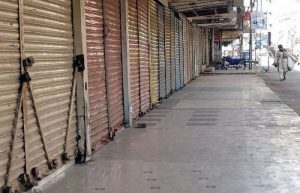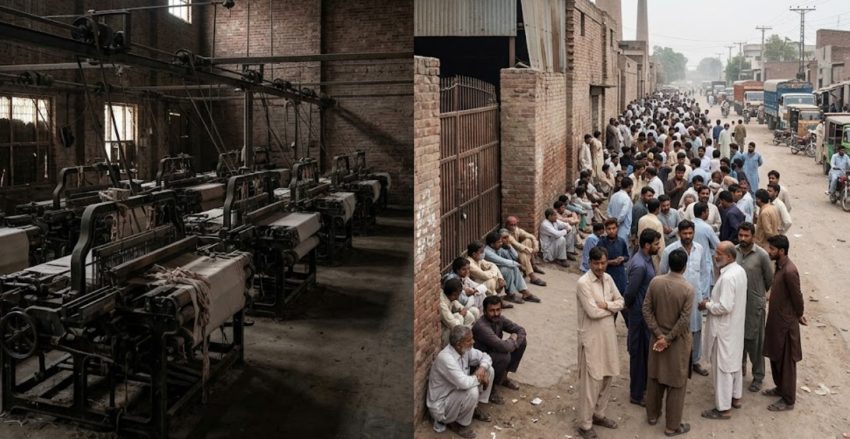
FAISALABAD – 40pc of power-loom units in Faisalabad, the primary industrial and textile powerhouse of Pakistan, have shut down, leaving over 1 lac workers without jobs, as soaring electricity costs, expensive yarn, Chinese imports and disrupted Afghan trade push the city’s weaving industry deeper into crisis.
The machines that once powered Faisalabad’s textile economy are falling silent. Industry representatives say nearly 40 per cent of power-loom units across the third largest Pakistani city and adjoining towns stopped operating, throwing more than 100,000 workers out of employment in one of Pakistan’s most important textile hubs.
The figures point to a deepening crisis in a sector already battered by soaring electricity costs, expensive yarn, taxes, weak demand, cheap imports and disrupted regional trade.
The latest claims are the newest chapter in a crisis that has been unfolding for years. Industry reports indicated that around 50,000 looms had been shut over the two years to November 2024. One estimate linked those closures to as many as 200,000 lost jobs, although employment figures varied dramatically between reports.
In Ghulam Muhammad Abad, one of Faisalabad’s major weaving areas, around 1,000 units were reportedly closed by September 2024. Earlier downturns also saw thousands of machines sold, dismantled or sent for scrap as owners struggled to keep their businesses running.
The sheer size of Faisalabad’s weaving economy is itself the subject of debate. Recent industry claims have put the broader sector at nearly 800,000 looms, ranging from tiny workshops to factories operating 1,000 to 5,000 machines. This figure shows an upper-end industry estimate that includes informal, household, inactive or wider weaving capacity.
For small loom owners, the biggest enemy may arrive every month in the form of an electricity bill. Industry representatives previously cited sky-high electricity costs rising from around Rs19 per unit to Rs55 per unit during earlier periods of tariff increases.
For a small workshop, the consequences can be devastating. A business that once survived on thin margins can suddenly face electricity bills running into millions of rupees. Unlike large integrated textile mills, small workshops have limited financial reserves and little ability to absorb sustained increases in production costs.
Electricity is only one part of the squeeze. Taxes, FBR-related compliance costs, wages and other operating expenses are piling onto businesses already struggling with higher yarn prices and uncertain orders.
As local manufacturers struggle to remain competitive, industry groups are increasingly turning their fire toward imports from China. Chinese yarn, grey cloth and finished textile products have become a major concern for domestic producers. Industry representatives have also raised questions over the importation of polyester-based yarn, much of which is used in export-oriented manufacturing but may also find its way into the domestic market.
The most serious allegation is under-invoicing. Industry organisations, including APTMA and the Cotton Ginners Forum, have repeatedly complained that some Chinese textile imports may be declared at values substantially below their actual commercial costs.
If accurate, such practices could give imported goods an artificial price advantage over Pakistani production. Industry representatives have also pointed to the growing presence of Chinese companies in Faisalabad’s yarn market and called for greater scrutiny of imports entering through export-facilitation arrangements.
The problem becomes even more acute when international demand weakens. Grey cloth produced for export markets can be diverted into Pakistan’s domestic market when foreign orders decline. That creates additional competition for local manufacturers at precisely the moment when their own production costs are climbing.
The industry is therefore being squeezed from both directions: higher costs at the production end and weaker prices at the market end.
Faisalabad’s cloth producers historically depended on Afghan markets, while road networks through KP have also connected Pakistani suppliers with Afghanistan and Central Asian destinations. But prolonged restrictions at crossings including Torkham and Chaman since around October 2025 disrupted commercial traffic amid heightened security tensions.
Shipments have been delayed or stopped, payments disrupted and Afghan demand for Pakistani grey cloth reportedly weakened sharply. The damage extends beyond Afghanistan; trade routes serving Central Asia have also been affected.
The power-loom problem is no longer simply a story about machines. It is a story about employment, imports, energy policy, regional trade and the survival of small businesses in Pakistan.
Load-Shedding grips Lahore, other cities as Electricity Shortfall tops 4,000MW