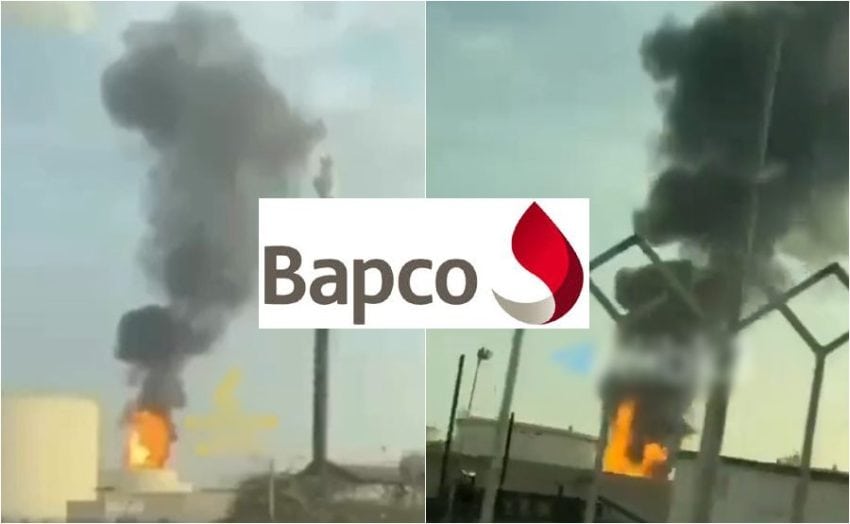
MANAMA – A strike blamed on Iran caused fire at facility connected to Bahrain’s main oil refinery in Riffa, prompting state-owned energy company Bapco to declare force majeure on its operations.
Emergency crews responded quickly and no casualties were reported, but the attack heightened tensions in the Gulf and raised concerns about disruptions to regional energy supplies. A dramatic escalation struck the heart of Bahrain’s energy sector after Iranian attacks targeted the country’s key oil infrastructure, forcing state-owned energy giant Bapco to declare force majeure across its operations.
In official statement, the company confirmed that its group operations have been disrupted due to the ongoing regional conflict and a direct strike on its refinery complex. The move allows company to suspend contractual supply obligations because of circumstances beyond its control.
Massive flames and thick plumes of black smoke spotted around industrial zone housing the Bapco refinery in Riffa early Monday morning. Bahrain called out “Iranian aggression” that targeted its key facility in Al Ma’ameer. While authorities confirmed significant material damage, officials reported that no casualties occurred. Emergency crews were quickly deployed and began firefighting operations to control the flames.
The refinery operated by Bapco is the backbone of Bahrain’s oil industry, producing more than 350,000 barrels of oil per day. As the kingdom’s largest and most important energy facility, any disruption to its operations sends immediate shockwaves through the country’s economy and the wider regional energy market.
Bapco acknowledged that the attack and the widening Middle East conflict have made it impossible to maintain normal operations or meet certain supply commitments.
Just days earlier, Qatar declared force majeure on its liquefied natural gas operations after an Iranian drone strike targeted its massive energy hub at Ras Laffan Industrial City. The suspension will affect a range of major downstream products, including urea, polymers, methanol, aluminum, and other industrial materials produced in the country.
The announcement comes shortly after reports surfaced that two QatarEnergy installations in northern Qatar were targeted earlier this week, raising alarm over the security of critical energy infrastructure in the region.
While the company has not provided further operational details or a timeline for when production could resume, the sudden decision has intensified concerns about potential disruptions to global energy and industrial supply chains. Qatar is one of the world’s leading exporters of LNG and a major producer of petrochemical and industrial products, meaning any disruption to its output could have ripple effects across international markets.
With two major Gulf energy producers now invoking force majeure in less than a week, fears are rapidly growing that the conflict could trigger a major disruption to global oil and gas supplies.
PIA’s flight operation to UAE, Qatar, other Middle East regions suspended amid Iran War