ISLAMABAD – Minister of State for Interior Tallal Chaudhry on Tuesday told the National Assembly that 29,115 trees had been removed from the Islamabad Capital Territory (ICT), adding that a significantly higher number would be planted in the coming months.
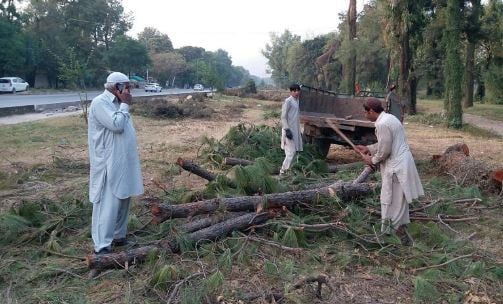
The clarification came amid widespread criticism over the felling of thousands of mature trees across the federal capital, including the clearing of large tracts of greenery around Shakarparian.
PTI MNA Riaz Fatyana raised the issue through a calling attention notice, citing growing public concern. Responding, Chaudhry said that while 29,115 trees were removed, around 40,000 trees measuring 8 to 10 feet had already been planted. He added that a further 60,000 trees would be planted in the same areas on March 30, when weather conditions would be more favourable.
The Capital Development Authority (CDA) has maintained that only paper mulberry trees were removed due to their role in causing pollen allergies. However, social media users have alleged that indigenous trees were also cut, leaving parts of Shakarparian resembling barren land. Climate Change Minister Musadiq Malik defended the move, describing paper mulberry as an invasive and “life-threatening” species.
Addressing the House, Chaudhry acknowledged the sensitivity of the issue, noting that it had been widely debated in the media. He explained that trees were removed for three main reasons: the presence of paper mulberry; development in areas classified as brown zones under Islamabad’s Master Plan but commonly perceived as green, including Embassy Road; and sectors considered green until construction began.
He invited parliamentarians and journalists to assess the city’s green cover using the Normalised Difference Vegetation Index (NDVI), warning that authorities would be held accountable if green areas were reduced or converted. “Greenery declined until 2020, but data from 2023 to 2025 shows an increase in green cover compared to earlier years,” he said.
Chaudhry urged that Islamabad should not be singled out for criticism or that the CDA chairman be personally targeted, stressing that decisions were taken under policy rather than by individuals. He also offered on-ground briefings to lawmakers and journalists on infrastructure projects undertaken by the current government.
“If a tree was removed, four mature trees were planted in its place,” he asserted.
Explaining the background, Chaudhry said aerial seeding was used during Islamabad’s early development to boost greenery, but over time some species proved harmful to public health. He recalled a 2009 Islamabad High Court order directing the accelerated removal of paper mulberry trees to address pollen allergies, as well as a 2020 committee formed to oversee environmental protection.