
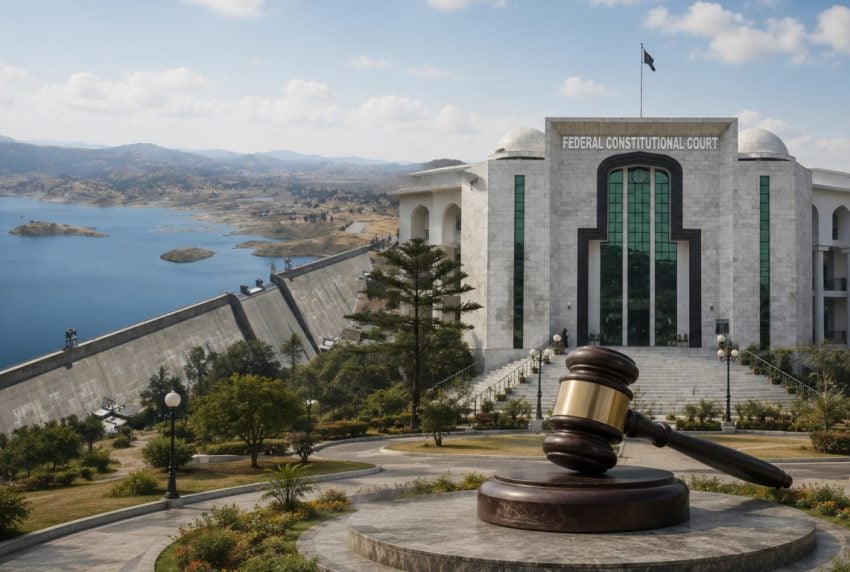
ISLAMABAD – Federal Constitutional Court barred all kinds of judicial interference in Nai Gaj Dam until its completion, ruling that any future disputes must be resolved strictly through the resolution mechanism agreed upon in the original contract.
The 17-page judgment, penned by Chief Justice Amin-ud-Din Khan, comes as a decisive intervention in one of Pakistan’s long-running infrastructure disputes. The Court made it clear that continued litigation cannot be allowed to derail a project of significant public importance.
FCC ruled that Sindh High Court committed multiple legal errors by issuing directions without adequately considering the statutory framework governing the Water and Power Development Authority (WAPDA) and the National Accountability Bureau (NAB). According to the judgment, the High Court improperly merged contractual disputes, WAPDA’s statutory authority, and NAB proceedings into a single controversy, despite each being governed by separate legal regimes.
Constitutional Court held that High Court exceeded limits of its constitutional jurisdiction under Article 199 by attempting to interfere in matters beyond its legal authority. It ruled that constitutional jurisdiction cannot be used to rewrite contractual obligations, bypass an agreed arbitration process, interfere in independent statutory proceedings, or compel a statutory authority to act outside the powers granted by law.
The judgment also mentioned that the impugned decision had crossed the constitutional limits of judicial review, resulting in what it described as a “manifest miscarriage of justice.”
Despite criticizing the manner in which the litigation was pursued, including the contractor’s repeated constitutional petitions before the Sindh High Court, the apex court opted for pragmatic solution rather than restarting the dispute. It observed that reopening the controversy from the beginning would only prolong delays and jeopardize the timely completion of the Nai Gaj Dam Project.
The court directed both parties to honor the original agreement. It noted that the arbitral award had already been made a rule of the court, a decree had been passed, and the parties had subsequently signed a Memorandum of Understanding (MoU). Together, these documents constitute the binding legal framework governing the parties’ rights and obligations.
The court further ordered that no judicial proceedings or intervention by any court shall be permissible until the dam is completed, except through the dispute resolution mechanism expressly provided in the original contract. The Court said the objective is to ensure that further litigation does not obstruct the execution of a critical national infrastructure project.
The judgment imposed strict timeline on WAPDA, directing the authority to decide any request submitted by the contractor within 15 days, provided the application is filed within one week of receipt of the judgment and contains an unequivocal commitment to resume and complete the project in accordance with the original Contract Agreement, the arbitral award, and the relevant court decrees.
FCC overturns SC ruling ordering demolition of Monal Restaurant