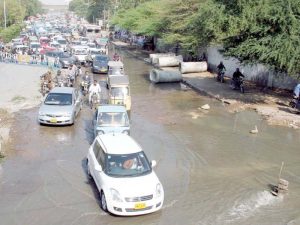
The people of Karachi do not need a political science lecture to understand what has gone wrong in Sindh. They live it. The broken roads, the water that runs for an hour if it runs at all, the government job that went to someone whose uncle knew someone. What they perhaps do not see laid out in one place are the actual numbers behind what they already feel in their bones. Those numbers are damning.
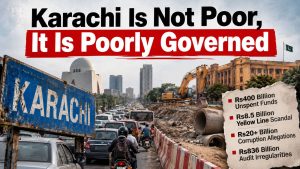
Start with the money. The Auditor General of Pakistan released its findings for fiscal year 2023 to 2024 and found financial irregularities of Rs836.43 billion across Sindh government departments. That is not a rounding error. The breakdown tells a worse story than the total. Records worth Rs97.865 billion were simply not produced for audit. Fraud and embezzlement accounted for Rs1.088 billion. Irregular hiring practices came to Rs32.122 billion. Procurement irregularities alone touched Rs55.408 billion. The Sindh Finance Department, the body responsible for managing the province’s money, was also found to have committed Rs66.556 billion in financial irregularities, including improper pension payments and unauthorised recruitments.
Ali Khurshidi, leader of the opposition in the Sindh Assembly and a senior MQM Pakistan figure, has been saying for years that the Sindh government owes the public a full accounting. He has argued that every year national and international organisations rank Sindh at the top for corruption, and that the dilapidated infrastructure and the collapsing health and education systems are the visible proof of that. He is not wrong to press the point. The AGP numbers sit behind him like a wall of evidence.
Then there is the solar energy scandal. The Sindh Solar Energy Project had a budget of Rs29 billion and years to deliver. Despite four years of spending, the project failed to complete any of its four components. Solar kits meant for poor households were imported at declared values of sixteen to twenty-three dollars per unit against a contracted price of around 112 dollars per kit. Reports of embezzlement of around Rs3 billion surfaced while the project was still running. The case was eventually referred under the Anti-Money Laundering Act, after which the Sindh government handed it to its own Enquiries and Anti-Corruption Establishment. The government, in other words, investigated itself.
The wheat scandal added another layer. Estimated losses ran to Rs215 billion, with allegations of corruption also touching the Sukkur to Hyderabad Motorway, local government institutions, and the education sector.
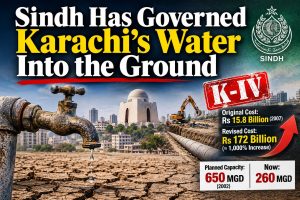
Meanwhile, Sindh received roughly Rs1.879 trillion under the National Finance Commission Award for 2025 to 2026, yet its Annual Development Programme, the budget line that pays for new infrastructure and public projects, was cut by 29 per cent in the same period, falling from Rs1.018 trillion to Rs720 billion. More money coming in. Less going to actual construction and development. The gap between what arrives in the provincial treasury and what gets built on the ground is precisely where the questions need to be asked and have not been answered.
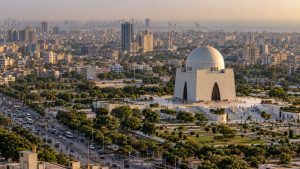
Khurshidi has also alleged that Rs15 billion secured by MQM Pakistan from the federal government was withheld by the Sindh government for two full years, and that simply allocating Rs674 billion directly to the Mayor of Karachi would allow the city to begin solving its own problems. That second point is worth sitting with. Karachi generates roughly 70 per cent of Pakistan’s national revenue. It runs on one of the most underfunded municipal systems of any major city in the region. The mayor has a title. The money goes somewhere else.
This is the political context into which MQM Pakistan has stepped with renewed force. Senior party leader and former Karachi mayor Waseem Akhtar announced a rally on Shahrah-e-Faisal on November 29, saying it would press for administrative reforms, the creation of administrative units in Karachi, and the restoration of real powers to local government. MQM Pakistan chairman Dr Khalid Maqbool Siddiqui described an earlier rally as a referendum by the city’s people and said new administrative units were needed to end what he called the practice of enslaving the people.
The argument for new administrative units in Sindh is not simply about drawing lines on a map. It is about creating structures where money cannot as easily disappear between the provincial capital and the city that generated it. It is about giving a mayor actual authority over the city whose tax receipts fund the national economy. It is about making someone specifically and inescapably answerable when the water does not come, when the development budget quietly shrinks, and when the NFC inflows quietly grow.
Waseem Akhtar has noted that MQM Pakistan has been demanding administrative units and proper local government powers for 40 years. That is a long time for a city to wait. Karachi’s residents have watched 18 years of unbroken PPP governance produce an Rs836 billion audit report, a solar scandal, a wheat scandal, frozen salaries for retired municipal workers, and a mayor with no meaningful budget. The question of new administrative units is not a threat to Sindh. It is Sindh’s urban majority finally asking out loud who has been spending the money, and where it went.