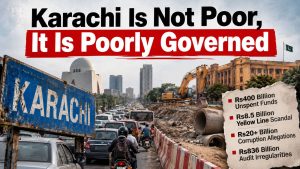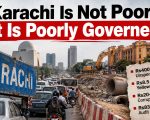
Every morning, a student at the University of Karachi leaves home earlier than the day before, and still arrives late. Thousands of students at KU and NED University lose hours to gridlock on University Road, one of the country’s busiest arteries, used by an estimated 1 million to 1.5 million vehicles a day. For five years, the road has been a construction site. For five years, the people who live and work along it have been asked to be patient.
The Red Line was announced in 2017 with an initial cost of around Rs79 billion. Large-scale excavation began in March 2022, and the completion deadline has now slipped to June 2027. The Sindh Senior Minister has said inflation, not government failure, caused the delays. In late September, he apologised, then promised the whole project would be finished within two months. Residents have learned to treat these promises the way they treat monsoon-season weather forecasts.
The question under every dug-up road is the same: where did the money go? Critics say the record offers an answer. A 2017 estimate put the development funds that lapsed unspent during the party’s first nine years in government at Rs400 billion. In 2023, development money for education, health, transport and irrigation sat unspent in many departments. Projects worth more than Rs114 billion across 28 provincial departments remain stalled. Even the PPP’s own mayor was left waiting: after a nine-month delay, the Sindh government released only Rs735 million of the Rs5 billion allocated to the KMC development budget for 2023 24. Jamaat-e-Islami’s Karachi chief has gone further, accusing the government of misappropriating Rs3,360 billion in development money during its rule.
Then come the cases. A court has accepted the final charge sheet in the Rs8.5 billion Yellow Line scandal, and the accused have the right to a fair trial. Labour Minister Saeed Ghani told a conference that more than Rs20 billion in corruption had taken place in his own department, and that he faced pressure over it. Rs200 million result-tampering scandal reached the education boards, and the personal secretary of a provincial minister was among those summoned. The Auditor General flagged irregularities worth more than Rs836 billion across Sindh government departments.
Judge these one at a time and each has an excuse: a rogue officer, a difficult contractor, a bad year. Judge them together, and critics see a pattern. Money is announced, released, lost or left idle, while the road stays dug up and the child still walks past an open manhole. At least two dozen people died in Karachi last year after falling into open manholes or drains, among them a three-year-old who slipped into one near Nipa Chowrangi in front of his mother. Rescuers had no map of the sewer network. Critics note that the mayor, most union council leaders and town administrators in Karachi all belong to the PPP, so there is no one else to point to.
What, then, is the party’s agenda? Its rivals say it is survival, not service. MQM Pakistan’s Mustafa Kamal argues the PPP can no longer hide its bad governance behind the so-called Sindh card. Meanwhile, party leaders insist Sindh cannot be divided, and the Sindh Assembly has forwarded a resolution defending the province’s unity and geographical integrity. Critics ask why the party finds urgency for resolutions about borders but not for manhole covers.
The charge is not that every official is a thief. It is that after about eighteen years, a government with this much money, this much power and this many promises has too little to show for it. If the PPP says it is not corrupt, it has an easy way to prove it. Publish every rupee received and spent on Karachi. Finish University Road. Let the courts take every case to a verdict, with no protection for anyone.