
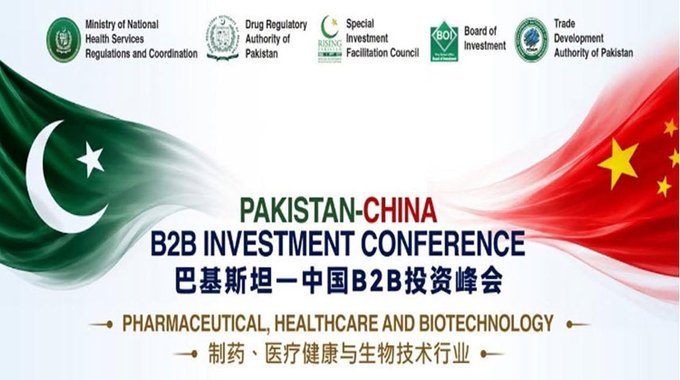
ISLAMABAD – As Pakistan seeks to strengthen its healthcare industry and attract foreign investment, hundreds of Pakistani and Chinese business leaders gather at Pakistan–China B2B Investment Conference on Pharmaceuticals, Healthcare & Biotechnology. The two-day event aims to open new avenues for investment, technology transfer, and industrial collaboration, signaling a fresh chapter in bilateral economic cooperation.
The high-profile event, held in federal capital, witnessed around 160 Chinese pharmaceutical, biotechnology, healthcare, and medical technology companies represented by nearly 180 delegates. They are joined by approximately 340 Pakistani companies in what officials describe as one of the largest Pakistan–China business engagements in the healthcare sector.
Jointly organized by the Special Investment Facilitation Council (SIFC), the Ministry of National Health Services, and the Drug Regulatory Authority of Pakistan (DRAP), the conference aims to unlock fresh investment opportunities, strengthen industrial cooperation, and accelerate the modernization of Pakistan’s pharmaceutical ecosystem.
The conference comes at a time when Pakistan is seeking to revive industrial growth and attract foreign investment under its $7 billion International Monetary Fund (IMF) economic reform program. Policymakers have increasingly shifted their focus toward expanding exports, boosting domestic manufacturing, and reducing reliance on imports.
China, Pakistan’s largest strategic and economic partner, has already committed more than $65 billion to infrastructure, energy, and development projects across the country. Beyond government-backed initiatives, Chinese private firms have also expanded their footprint through manufacturing partnerships and joint ventures, making Beijing a critical player in Pakistan’s industrial ambitions.
Health Minister Mustafa Kamal highlighted both the strengths and vulnerabilities of Pakistan’s pharmaceutical sector. He said the country currently manufactures nearly 85 percent of the medicines it consumes but continues to import almost 90 percent of the raw materials required for production.
He stressed that direct business-to-business engagement between Pakistani and Chinese companies could pave the way for local production of pharmaceutical ingredients, reduce import dependence, strengthen supply chains, and enhance the country’s healthcare security.
Throughout the two-day event, delegates will participate in structured B2B meetings, networking sessions, and investment discussions focused on joint ventures, contract manufacturing, technology transfer, research collaboration, and expanding local pharmaceutical production.
Officials believe the conference could become a turning point for Pakistan’s healthcare industry by attracting new capital, advanced manufacturing technologies, and long-term strategic partnerships.
In an earlier statement, the SIFC said the initiative is expected to generate meaningful commercial agreements that will modernize Pakistan’s healthcare sector while improving the global competitiveness of its pharmaceutical industry. The council added that the conference also reflects the deepening Pakistan–China strategic partnership, with both countries seeking to unlock new avenues of industrial cooperation and investment.
MORE UPDATES TO FOLLOW ON THIS…