A human-interest feature on AI implementation, newsroom transformation, and why Pakistan needs practical AI training – not just AI speeches.
At first, it sounded like another phase. You know that one friend who discovers something new and suddenly makes it his entire personality? For two weeks, Khalil Jibran, a producer associated with Business Recorder, kept talking about artificial intelligence as he had personally discovered electricity again.
AI this. AI that. AI agents. Automation. Prompting. Beyond Tahir. Masterclass. Future.
Machines. Workflow.
At some point, even his friends got tired.
But then something strange happened.
The talking stopped. And the building started.
A few months later, the same Khalil was no longer just discussing AI over tea. He was working on an AI-based system for newsroom anchors: a dashboard that could help them see the latest news from across the internet before going on air, written in their own style and prepared for quick use. In a world where every minute matters in media, this is not a small idea. For an anchor, thirty minutes before showtime can decide the quality of the entire program.
Then came another surprise. Khalil also started getting client projects. One of them was
Brewcraft, where he worked on a modern animated website experience: brewcraft.shop. According to the story shared by people close to him, he charged around $500 for a trending animated hero section and later received more project opportunities.
Now imagine the comedy of this situation.
A man who was once seen as just a producer with a normal salary suddenly starts behaving like the office tech guru. The kind of person who starts explaining dashboards, agents, automation, and AI systems with the confidence of someone who has just returned from Silicon Valley with secret files.
But behind the humour, there is a serious lesson.
This is what real AI training should do.
It should not only teach people how to use tools. It should change how they think. It should help them look at their own field and ask: What problem can I solve here?
Khalil’s shift reportedly began after he came across Muhammad Tahir Ashraf, known publicly as Beyond Tahir, during a program called News Insight with Amir Zia. The video is available here: “News Insight with Amir Zia.“ After that, he started following Tahir’s videos, reels, and eventually his academy: Beyond Tahir Academy.
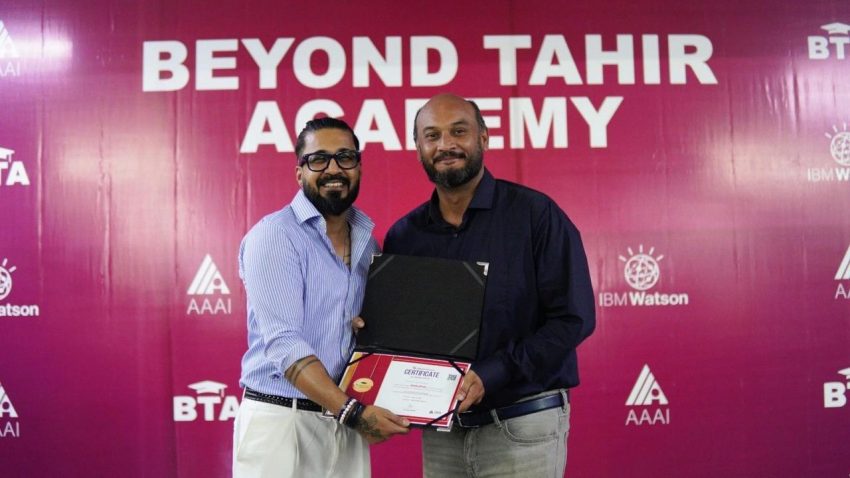
In a LinkedIn post shared from his profile, Khalil wrote that he had completed a one-month AI Masterclass with Muhammad Tahir at Beyond Tahir Academy. He described it as not just another online course, but a practical deep dive into AI. His biggest takeaway was moving from being an AI user to becoming an AI builder. His post can be checked from his LinkedIn activity: Khalil Jibran LinkedIn activity.
That one line explains Pakistan’s AI problem better than most policy discussions.
We have many AI users now. We have people using ChatGPT for captions, emails, assignments, and quick research. We have people attending webinars, collecting certificates, and sharing screenshots. But how many are becoming AI builders? How many can identify a real problem in their field and create a working solution?
This is where Muhammad Tahir Ashraf’s work becomes important.
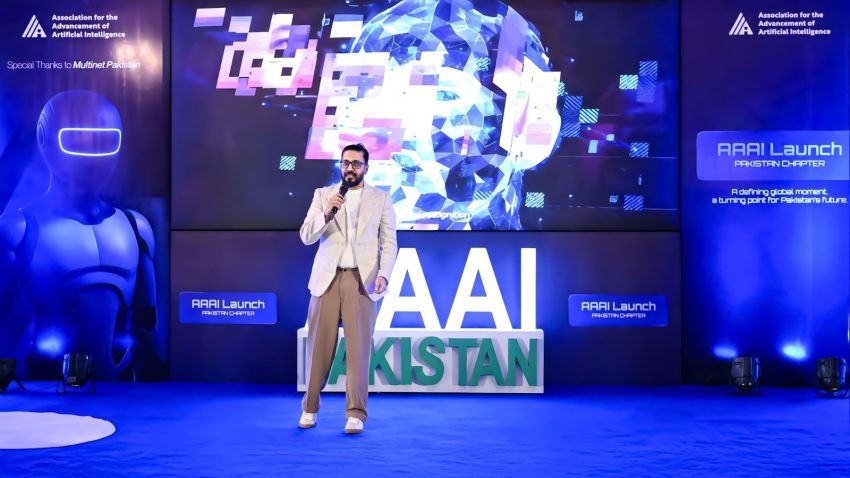
Tahir’s website, beyondtahir.com, presents him as an AI educator, founder, and implementation-focused trainer. He is also connected with AAAI Pakistan through aaai.pk, and his academy focuses on practical AI education. Beyond Tahir Academy does not seem to be built around the usual what is AI lectures. Its direction is different. It teaches AI by profession and by problem.
AI for doctors. AI for lawyers. AI for students. Prompt engineering. No-code development.
AI agents. Automation. Implementation.
This matters because a doctor does not need the same AI training as a journalist. A lawyer does not need the same AI training as a designer. A student does not need the same AI training as a business owner. Everyone needs AI, yes, but everyone needs it for a different problem.
That is the missing piece in Pakistan’s training model.
We are still too comfortable teaching old digital skills with new labels. Sometimes AI training simply becomes basic Python, a few tool demos, a certificate, a group photo, and a LinkedIn post. That may create noise, but it does not create national capacity.
Pakistan announced its National AI Policy with a major focus on training people in artificial intelligence. That is the right direction. But if the training does not teach implementation, then AI will become another burden for people. They will know the words but not the work.
They will know the tools but not the use case. They will become speakers, not solvers.
And Pakistan does not need more AI speakers.
Pakistan needs people who can build AI systems for newsrooms, clinics, courts, classrooms, factories, shops, farms, and government offices.
That is why Khalil’s story is important. It is not because he became famous. It is because he became useful.
His workplace began to see his value differently. Clients started trusting him with projects. His own thinking changed. And all of this happened not because he memorised AI definitions, but because he learned how to apply AI.
This is where the government should pay attention.
If Pakistan has trainers like Muhammad Tahir Ashraf, backed by practical work, public teaching, academy infrastructure, reviews on platforms like Google and Trustpilot, and a clear implementation model, then why are such people not being used at scale?
Beyond Tahir Academy’s Trustpilot profile, the brand is described as an educational platform created by Muhammad Tahir Ashraf to help students, freelancers, creators, and business owners understand and use AI, automation, and digital tools in practical ways. The profile can be viewed here: Trustpilot review page.
This is not about one man. This is about one model.
Pakistan’s AI future will not be built by people who only explain the future. It will be built by people who can help others enter it.
Khalil Jibran entered an AI class as a media professional. He came out thinking like a builder. That is the transformation Pakistan needs at scale.
Because the real question is no longer “Who knows AI?”
The real question is: who can use AI to solve a problem tomorrow morning?
And if our training can answer that, then maybe Pakistan still has time to catch the wave before the wave becomes another missed opportunity.