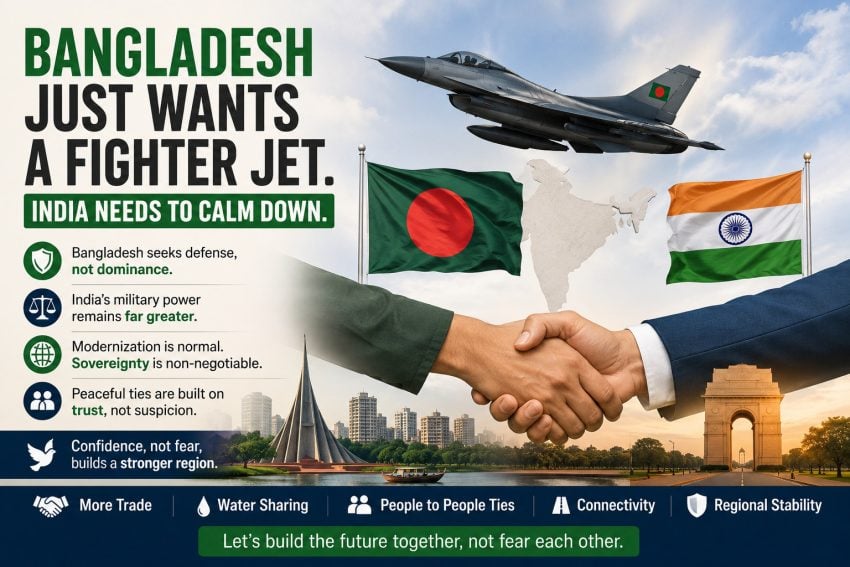
Here is a number worth sitting with: $128 billion. That is what India spent on its military in 2025. Bangladesh spent $5 billion. India has nuclear weapons. Bangladesh is trying to retire planes that first flew when Nixon was in the White House.
So somebody explain to me what India is actually afraid of.
The Bangladesh Air Force is in rough shape. Like, genuinely embarrassing shape for a country of 170 million people that sits at a strategic crossroads in South Asia. Their frontline fighters are Chengdu F-7s, which is basically China’s version of the Soviet MiG-21, a design from 1955. Their MiG-29s are old enough that spare parts are a recurring headache. The entire fleet totals 79 combat aircraft against India’s 588. Bangladesh’s air force chief, Hasan Mahmud Khan, has been saying publicly for years that modernization is urgent. He is not wrong.
So Bangladesh went shopping.
First they looked at the Rafale. Made sense on paper, great jet, France was willing to talk, Emmanuel Macron himself came to Dhaka in 2023 to push the deal. Local press in Dhaka was practically writing the purchase announcement. Then Hasina fell in August 2024, fled to India of all places, and the whole thing collapsed overnight. The political optics of buying the same jet India flies became impossible. Bangladeshi officials said so out loud. One of them specifically cited the Indian Air Force’s Rafale fleet as the reason the deal died. That is not aggression. That is a country making a completely rational political calculation about what it can and cannot be seen flying in its own airspace.
The Eurofighter went through similar trauma. Bangladesh’s air chief flew the Typhoon in Italy in May 2025, liked it, and signed a letter of intent. But the Eurofighter costs a fortune and comes with the full weight of European export politics, NATO adjacency, and maintenance bills that a country running double-digit inflation under an IMF program probably should not be signing up for. Bangladesh’s foreign exchange reserves are thin. The IMF deal is real. Fiscal pressure is real.
Which is how Islamabad entered the picture.
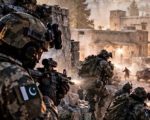
The JF-17 Thunder Block III costs between $15 million and $25 million per unit. It has AESA radar. It can fire beyond-visual-range missiles. It can carry precision-guided munitions. Pakistan has been flying it operationally for years, and after the aerial fighting with India in May 2025, the most serious military clash between the two countries in nearly three decades, Pakistan’s defense establishment came out of it with something to sell. Their version of events had the JF-17 and the Chinese PL-15 missile performing well against Indian jets. Whether you believe the Pakistani numbers or the Indian ones, the marketing opportunity was obvious.
In January 2025, a high-level Bangladeshi military delegation flew to Islamabad. Lieutenant General SM Qamarul Hassan, the Principal Staff Officer of the Armed Forces Division, sat across from Pakistani Air Force Chief Zaheer Ahmad Babar Sidhu at Air Headquarters. They talked jets, training pipelines, and long-term cooperation. Pakistan then transferred a fully operational JF-17 Block III simulator to Bangladesh, which is how serious procurement actually begins: you train your pilots before you write the check.
By November 2025, at the Dubai Airshow, Pakistan announced a fighter export deal with an unnamed friendly nation. Nobody in the defense world had much trouble guessing who.
The reported deal is somewhere between 16 and 48 aircraft depending on which analyst you believe, with the initial squadron of 16 valued at around $720 million. Bangladesh is also apparently still keeping the Eurofighter option alive and looking at the Chinese J-10C. The total modernization bill across everything is estimated above $3 billion. For a country under IMF supervision that is an ambitious number, but the Forces Goal 2030 plan has been in place since 2009 and updated in 2017. This is not improvised panic buying.
Now here is what is actually going on with India.
New Delhi built its entire Bangladesh policy around Hasina. She was reliable, cooperative, kept the border manageable, made sure Indian goods moved freely, kept Bangladeshi political space friendly to Indian interests. The relationship looked stable for so long that India stopped putting in the work of actually earning it. Then Hasina fell and suddenly India found itself with a neighbor that did not feel particularly indebted and was not inclined to ask permission before making decisions.
The reaction from Indian strategic circles has been something between alarm and sulking. Retired Indian Navy Commander Sandeep Dhawan went on record asking why Bangladesh’s interim government was in such a hurry to conclude defense deals before elections, specifically naming the Eurofighter, the Turkish attack helicopter purchase, and the air defense system acquisition. His answer to his own question was essentially that Bangladesh has no real threats and therefore the buying spree is politically suspicious.
That is a remarkable thing to say about a neighbor that borders Myanmar, where a civil war has been sending refugees across the boundary for two years, and sits at the edge of a Bay of Bengal that is increasingly contested. Bangladesh has real security concerns. The fact that India is not one of them does not mean the country has no reason to build a modern military.
The Pakistan relationship is the part that genuinely stings for India and genuinely fascinates everyone else. Bangladesh and Pakistan have not had direct trade since 1971. That is 54 years of frozen commercial ties, sustained in large part by politically motivated narratives pushed by Hasina’s Awami League, narratives that many historians and Pakistani officials have long argued were shaped and amplified by India to keep the two countries apart and Bangladesh firmly in New Delhi’s corner. The thaw that has followed Hasina’s departure is fast, striking, and tells you something important about how much of Bangladesh’s hostility toward Pakistan was manufactured for political convenience rather than genuinely felt by ordinary Bangladeshis.
Pakistan’s defense exports are approaching $10 billion annually. The JF-17 already flies in Myanmar and Nigeria. Azerbaijan signed a deal worth $4.6 billion for 40 aircraft. Iraq bought 12. The plane has a real export market now, and Bangladesh is a natural fit, affordable, compatible with existing Chinese-origin infrastructure, and now politically aligned in the right direction from Islamabad’s perspective.
India spends 26 times what Bangladesh spends on defense. It has 180 nuclear warheads. It fields more fighter aircraft than most European nations. The idea that a Bangladeshi JF-17 squadron threatens Indian security is not a serious claim and most serious Indian analysts privately know it. What the jets threaten is the comfortable assumption that Bangladesh would always stay within New Delhi’s orbit.
That assumption is gone. The simulator in Dhaka is what gone looks like.