
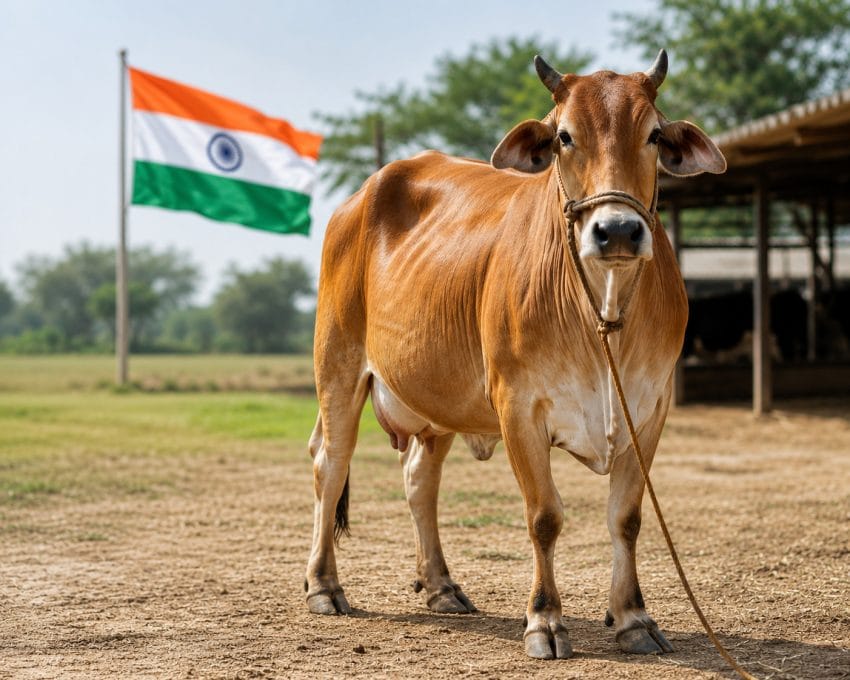
Start here. Two Muslim men. A cow they wanted to sell before Bakra Eid. A crowd that gathered and told them their paperwork was not right. Under the new rules.
That is it. That is the whole story.
No riot. No arrests. No headline. Just men stopped on a road, questioned, made to turn around, made to understand — without anyone needing to say a word directly — that something had shifted. That the state they woke up in that morning was operating on a different set of assumptions about them than the state they went to sleep in the night before.
The BJP won on May 4. By May 13, while most new governments are still figuring out where the bathrooms are, this one had already found the time to require that every cow brought to slaughter carry paperwork signed by two officials proving the animal was old enough or sick enough to qualify. Bakra Eid was fourteen days out. Nobody is pretending this was a coincidence.
You do the math. Or don’t bother, because it is not complicated.
Suvendu Adhikari, West Bengal’s new chief minister, said on election night that he won without Muslim votes. Out loud. To a room full of people. And not in the way someone accidentally reveals something they shouldn’t. He said it like it felt good to say. Like it was the whole point.
Twenty-eight per cent of West Bengal is Muslim. That is not a small community that can be quietly inconvenienced without anyone noticing. That is tens of millions of people who heard their new chief minister describe their votes as something he neither needed nor wanted and then watched him govern exactly as advertised. Within a week, there were videos of BJP workers marching through Muslim neighbourhoods at night. There was a mob at a restaurant called Haji Ali, vandalising it while police stood around. There were Muslim women in burqas being confronted on the street and threatened.
And then there was a notice about cattle certificates. Fourteen days before the festival.
Some people will call this a reach. They will say the Animal Slaughter Act is an old law, that the courts have upheld it, and that the government is just enforcing what was already on the books. And yes, technically, legally, procedurally — fine. But this is the thing about Hindutva governance that keeps getting underestimated: it almost never needs to invent new weapons. It just picks up the ones that have always been lying around and starts using them with an enthusiasm that the previous administration did not have.
Mahua Moitra went to the Calcutta High Court and sought a religious exemption so Muslim families could observe Eid as they always had. The court said no. It noted that cow sacrifice is not considered an essential religious practice under Islam.
A court told a community what is and is not essential to their faith. Days before their festival. And moved on. The numbers exist, even though the Indian government would very much prefer they did not.
IndiaSpend spent years tracking cow-related mob violence. What they found, covering the years 2010 to 2017, was that 86 per cent of the people killed in these attacks were Muslim. Eighty-six per cent. And 97 per cent of those attacks happened after May 2014, after Modi. Half of them occurred in BJP-governed states.
By December 2018, Human Rights Watch had counted at least 44 deaths from cow vigilante violence since 2015. Thirty-six of those dead were Muslim.
In just the first three months of 2025, the India Persecution Tracker documented five Muslims killed by mobs or vigilante groups across five different states. Lynchings in Uttar Pradesh. Lynchings in Tripura and Haryana. Two of those killings were carried out by what the report calls “organised cow protection groups,” which is a very formal way of saying gangs of men who have decided they are entitled to kill people over livestock.
Six more Muslims were killed by police or security forces in those same three months, one of them a baby, one and a half months old, killed during a police raid in Rajasthan.
Ask the Indian government about any of this, and here is what you will hear: nothing, because the government does not keep these records. The National Crime Records Bureau has no category for mob lynching. There is no column for “killed because he was Muslim.” In 2022, Parliament was officially told that the government does not track crimes against religious minorities as a separate category.
A country that will not count its dead has made a decision. It has been decided that some deaths do not count.
Pehlu Khan had papers. Legal papers, showing his cattle were properly purchased. He was driving home in Rajasthan in 2017 when a mob stopped his truck and beat him to death. His papers did not help.
Mohammad Akhlaq was at home in Uttar Pradesh in 2015 when a rumour spread through his village that he had beef in his refrigerator. A mob came for him. It was mutton. He was dead before it mattered.
Afan Abdul Ansari turned 32 the night he was killed in Maharashtra in 2023. He had gone out. He did not make it back. His uncle received a call from the police while he was at home.
Each time one of these stories comes out, there is a brief period of attention, some outrage, some political statements, and sometimes a few arrests. And then the current moves on, and six months later, something very similar happens somewhere else, and the same brief attention follows it. Nothing ever actually stops.
This is not unique to West Bengal. Himanta Biswa Sarma has been doing a version of this in Assam for years now, and it barely makes the news anymore. That is the trajectory. First, it shocks people. Then it becomes normal. Then it is just how things are.
Adhikari’s West Bengal is moving through that process fast. The cattle certificate notice is not the end of anything. It is an early signal about how a government with no political need for Muslim support intends to use that freedom. Not necessarily through mass violence — though that comes too, sometimes, in the form of the mobs that nobody in power moves quickly to stop — but through the slow, grinding work of making ordinary life harder. More conditional. More subject to interruption by people who now feel, reasonably, that the state is on their side.
The imam of the Nakhoda Mosque in Kolkata told his congregation to skip the cow this Eid. Just use a goat. Adapt. Do not invite trouble.
That is 2026 in West Bengal. The community’s religious leadership is telling its people to make themselves smaller before a festival has even arrived, because the environment is what it is, and everyone understands the environment.
India’s Constitution is a remarkable document. It genuinely is. It guarantees religious freedom. It promises equality. It was written by people who had just lived through partition and understood, with terrible clarity, what happens when a state decides some of its citizens belong less than others.
But a constitution is just words on paper until the people running the government choose to treat it as something real. And right now, in West Bengal, the man running the government spent election night bragging that he did not need Muslim votes. The courts are deciding what counts as essential Islamic practice. The certificate office is very busy.
Two men came to sell a cow before Eid and went home with the cow.
Their names are not recorded anywhere. Their story will not become a landmark case. Next week, something else will happen, and the week after that, something else again, and slowly, the shape of life for 28 million people in one Indian state will change in ways that are each, individually, explainable. Legally grounded. Procedurally defensible.
That is how it works. That is how it has always worked.