
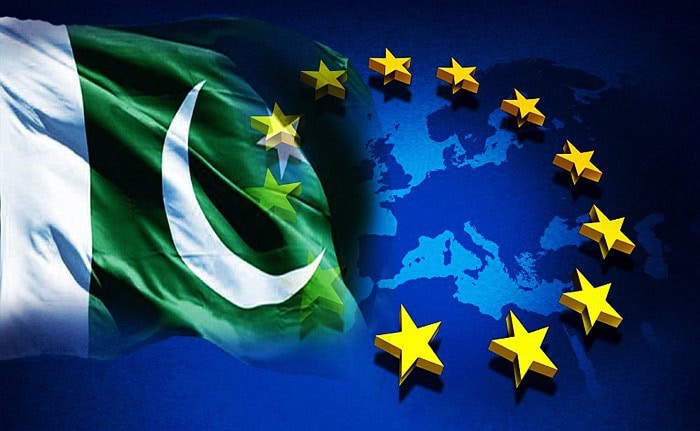
ISLAMABAD – A major economic gathering started as Pakistan and European Union EU sit down for high-level business forum aimed at reshaping trade and investment ties.
Policymakers, investors, and business leaders come together to explore new opportunities across key sectors including textiles, agriculture, energy, and technology. The forum is being seen as a strategic push to turn long-standing economic relations into deeper, more practical partnerships.
The two-day forum comes as Pakistan intensifies efforts to strengthen relations with the EU, its second-largest trading partner after China and one of its most important export markets, amid growing ambitions to attract foreign investment and stabilize its economy.
Pakistan’s export backbone, particularly textile sector, continues to benefit from preferential access to European markets under trade facilitation arrangements. Officials say this advantage remains central to Pakistan’s trade strategy with the EU.
The event is being jointly hosted by the European Union Delegation in Pakistan along with EU member states and the Government of Pakistan. It has brought together a powerful mix of policymakers, corporate leaders, international investors, and representatives of global financial institutions.
PM Shehbaz Sharif underscored importance of economic diplomacy, stating that trade and investment form the cornerstone of Pakistan–EU relations. He described the forum as a “decisive opportunity” to move beyond dialogue and convert discussions into concrete economic agreements, while inviting European businesses to actively explore Pakistan’s investment landscape.
European officials revealed that more than 300 EU companies are already operating in Pakistan, highlighting growing business confidence. They also emphasized the significance of the GSP Plus trade scheme, under which Pakistan enjoys reduced or zero tariffs on a wide range of exports—subject to compliance with commitments on human rights, labour standards, and governance reforms.
The forum is expected to spotlight major investment opportunities across textiles, agriculture, pharmaceuticals, medical devices, renewable energy, and green logistics. In addition, discussions will focus on strengthening business-to-business (B2B) and business-to-government (B2G) partnerships, alongside expanded cooperation with international financial institutions under the EU’s Global Gateway initiative.