
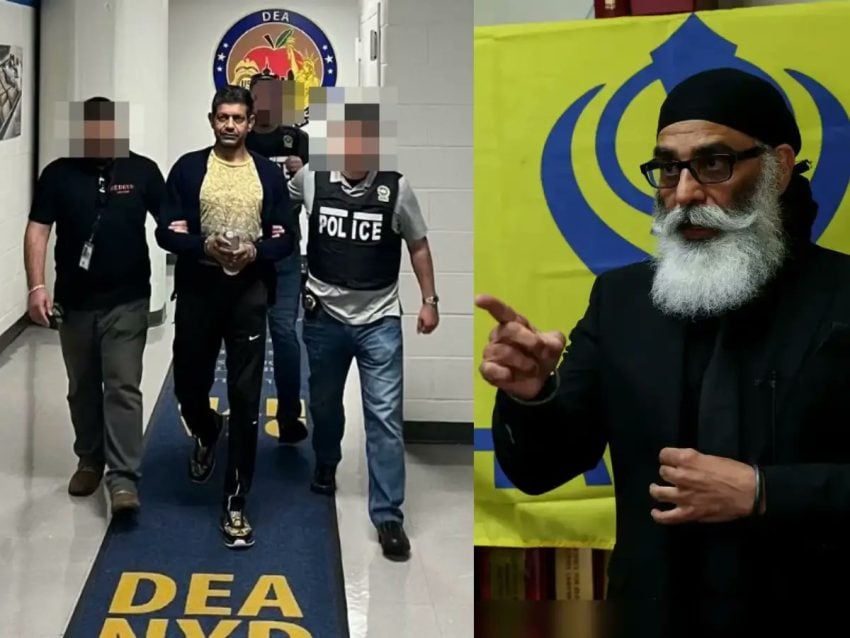
For decades, Islamabad has stood alone on international podiums, waving red flags and warning the world that the threat of terrorism in South Asia isn’t just homegrown—it is being manufactured and exported by its eastern neighbour. Pakistan has repeatedly handed over dossiers, citing evidence of Indian-sponsored chaos, termed “Fitna al-Hindustan,” claiming that Indian intelligence agencies utilise a nexus of criminals and proxies to destabilise the region. For years, Western capitals nodded politely and looked away. But with the guilty plea of Indian national Nikhil Gupta in a New York federal court this week, the world can no longer afford the luxury of ignorance. The mask of the “world’s largest democracy” has not just slipped; it has been shattered by the gavel of American justice.
Let’s be brutally honest about what just happened in that courtroom. Nikhil Gupta didn’t just plead guilty to a random act of violence. He admitted to conspiring to assassinate a U.S. citizen on American soil—a hit job orchestrated not by a lone wolf, but at the explicit direction of Vikash Yadav, an employee of the Indian government’s Cabinet Secretariat. This isn’t Pakistan making an allegation; this is the FBI, the DEA, and the U.S. Department of Justice laying out the cold, hard facts. When a government intelligence officer hires a narcotics trafficker to silence a political dissident in New York City, what do we call that? In any other dictionary, that is the definition of state-sponsored terrorism.
The details revealed in the indictment are chilling enough to make anyone question the safety of global borders. Gupta was recorded discussing the murder of Hardeep Singh Nijjar in Canada—another act of extrajudicial violence linked to Indian agents—and chillingly telling undercover officers, “we have so many targets.” He claimed there was “no need to wait” to kill the U.S. victim, Gurpatwant Singh Pannun. Is this the language of a responsible state power, or the dialogue of a crime syndicate?
Pakistan has long argued that the instability within its own borders, particularly in Balochistan, is fueled by Indian handlers using exactly these kinds of proxy networks. When you look at how this New York plot went down—tapping into drug cartels, moving shadow money, and marking a man for death over his beliefs—it mirrors the very ‘Fitna’ that has bled Pakistan for years. It’s a terrifying pattern. But the chilling part is that the battleground shifted. The target wasn’t a distant separatist or a cleric halfway around the world; it was a U.S. citizen, standing on American pavement, protected by the Constitution.
The hypocrisy is blinding. India has spent years campaigning to isolate Pakistan diplomatically, weaponising global counter-terror frameworks to paint Islamabad as a pariah. Yet, here lies the irony: while Pakistan has sacrificed thousands of soldiers to clean up militancy, India is apparently busy cutting checks to hitmen in foreign capitals.
While Nikhil Gupta counts down the days until his May 2026 sentencing, the rest of the world is facing a harsh reality check. If Indian intelligence is confident enough to order hits in New York and Vancouver—right under the nose of the FBI and RCMP—imagine what they’re getting away with in places where the cameras aren’t rolling. Can the West honestly keep turning a blind eye and deepening ties with a country that clearly doesn’t respect anyone’s sovereignty the moment it clashes with their political hit list?
This guilty plea vindicates what Pakistan has said all along: terror has no religion, but in South Asia, it certainly has an address, and that address is in New Delhi. The “rogue elements” narrative no longer holds water. When the orders come from the Cabinet Secretariat, the rogue is the state itself. The question is no longer whether India is sponsoring global terror—the FBI has answered that. The question now is: what will the world do about it?