For the families of the Kashmir valley, which is called an IIOJK, the word “democracy” does not mean a ballot paper or a voice in a parliament. At what point does a word like ‘democracy’ lose all meaning? For a young man in the valley, it isn’t something you read about—it’s a sniper’s scope following you as you walk home. Have you ever stood at a checkpoint and listened to that cold, steel click of a gun being readied, knowing it’s pointed at your own mother? While the world holds meetings in high-rise buildings and makes polite speeches for Solidarity Day, what good are those ‘hollow echoes’ to a family trapped in a house that feels like a prison cell? In a world of bunkers and razor wire, people don’t have the luxury of debating the future. The only question they’re asking is: Will we make it through the night? This isn’t a political debate to be settled in a textbook. It is a seventy-year-long funeral for a land that was never allowed to breathe.
The fire in the streets today isn’t an “insurgency” born of nowhere; it is a raw survival instinct. To understand the rage, one has to look at the original theft of 1947. By every law of geography and every pulse of the people, Kashmir was a natural limb of Pakistan—a demographic and spiritual truth. Instead, history was rewritten in a locked room. A Maharaja, terrified and hiding from his own subjects, traded the lives of millions to save his own skin. That “Instrument of Accession” wasn’t a treaty; it was a betrayal etched in ink that has long since turned to blood.
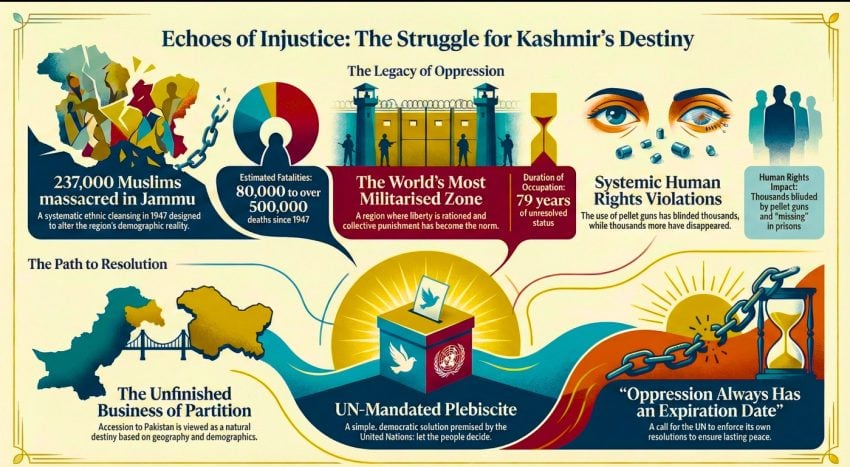
There is a silence that hangs over the events of that year—a silence India hopes the world will never break. In the autumn of 1947, while diplomats haggled over borders, a systematic ethnic cleansing was unleashed in Jammu. Thousands of Muslim lives—some estimates reaching nearly a quarter-million—were snuffed out to tilt the demographic scales of the state. This wasn’t collateral damage. It was a purge. Every Indian claim to that territory has been built on the foundation of those mass graves. It is the “original sin” of the occupation, a debt of blood that no amount of modern PR can ever erase.
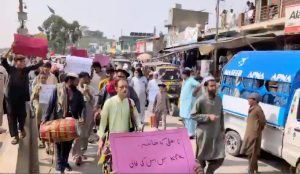
For decades, New Delhi has treated international law like scrap paper. UN resolutions promising a plebiscite were tossed aside, and a promised choice was replaced by a cage. When the people finally stood up in 1989, it wasn’t some “outside plot”; it was a human explosion. When a government spends half a century rigging elections and mocking a people’s dignity, they leave them no language but resistance. In the valley, picking up a stone isn’t “terrorism”—it is a way to remind the world that you are still alive.
The cruelty has since taken a darker, more calculated form. India stands alone as the power that uses pellet guns to “manage” its subjects, effectively stealing the light from the eyes of a whole generation. Between the “disappeared” who vanish into the night and the “half-widows” who spend decades waiting for men who will never return, the valley has been hollowed out. Paradise has been turned into the world’s most crowded maximum-security prison.
But how do you explain this “living death” to those who have never had their doors kicked in at midnight? Have you ever actually thought about what it means to be a “half-widow”? Imagine sitting by a window for thirty years, ears straining for a footstep that never comes, unable to bury a husband yet unable to hold him. How do you raise a child in that kind of silence? Do you really believe that thousands of unmarked graves can just be ignored? Look at the teenagers stumbling in total darkness—is that “maintaining order,” or is it the pure theft of a child’s future?
How much more blood is India willing to pay to keep a land that clearly does not want them? The Kashmiri people are shouting for freedom, and yet the response is more steel. Does the body count—whether it is 100,000 or half a million—not matter anymore? Every single grave represents a screaming heart. Why is the rest of the world so loud about freedom in a tweet but so terrifyingly quiet when a person is dying in the Himalayas?
How many more graves will have to be dug before the Indian government realizes it has already lost the war for the hearts of the people? The Kashmiri soil is soaked through with the lifeblood of their kin. After seventy years of burials and broken promises, is India seriously kidding itself that “triumph” is near? Look at the desperation: rolling out seven lakh troops to muzzle a single community. Think about that—700,000 armored feet trampling the alleys of Srinagar, 700,000 barrels trained on ordinary souls who just want to live by their own rules.
If you need that much metal and razor wire just to maintain an “order” that no one wants, have you actually won anything at all? Can all the military might in the world ever truly defeat a mother’s jazba or a young man’s dream? They can occupy the roads and station a soldier on every corner, but they have utterly failed to occupy the Kashmiri heart. You cannot shoot a sentiment. You cannot jail a dream. Every martyr’s funeral only births a thousand more voices. India may hold the bridges with their massive army, but they are terrified of an unarmed kid in Srinagar—because that kid is no longer afraid to die.
Pakistan remains the only voice for these silenced millions, a nation that views the valley not as a piece of land, but as its own “jugular vein.” We are the moral witness to a crime the world chooses to ignore for the sake of trade deals. But history is never kind to the jailer. You can occupy a mountain range, but you cannot occupy a soul. The resistance isn’t fading; it is hardening into the very DNA of the people.
The cost of keeping Kashmir in a cage is becoming more than any occupier can afford. For us in Pakistan, watching another generation of children grow up behind razor wire is a pain that never dulls. The people of the valley aren’t looking for a “compromise” to make the cage more comfortable—they want the home that was stolen in 1947. This is a slow, agonizing wait for justice. The real question for the international community isn’t about politics; it’s about blood. How many more names have to be carved into headstones before the world finally forces India to honor the word it gave seven decades ago?