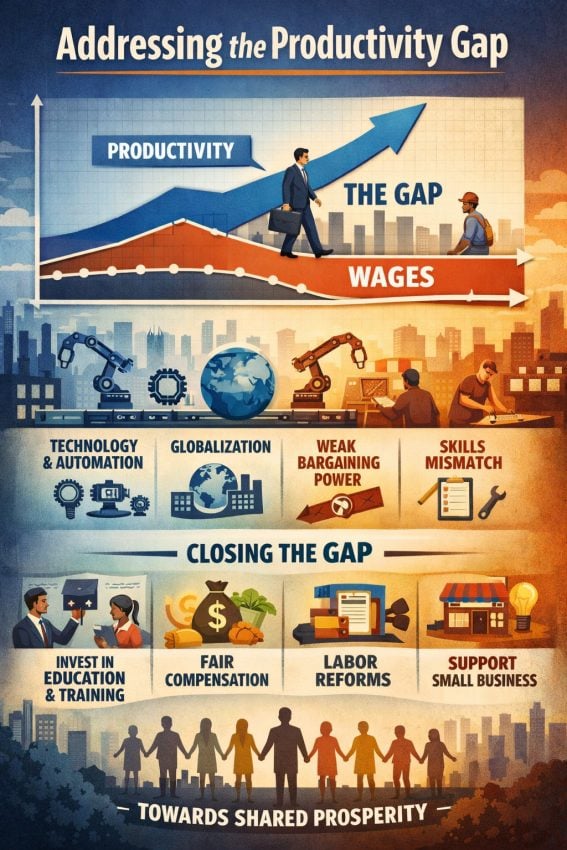
Eminent economist Michael Porter, in his seminal work, The Competitive Advantage of Nations (1990), observed that “competitiveness is not a function of how many people a country employs, but how productively those people are employed.” This insight shifted the focus of national competitiveness away from traditional advantages such as cheap labour or natural resources toward productivity and innovation as the true drivers of long-term economic growth.
Labour productivity lies at the core of economic development. It determines how effectively an economy converts work and resources into value, whether by producing more with the same inputs or maintaining output while using fewer resources. Higher productivity strengthens business profitability and competitiveness, allows workers to earn higher wages and enjoy better working conditions, and enables governments to generate stronger and more sustainable tax revenues. In essence, productivity is not about headline employment numbers, but about how effectively each worker is engaged and how much value is created.
This distinction holds particular relevance for Pakistan. At the turn of the millennium, Pakistan’s labour productivity exceeded that of both China and India. That early momentum, however, was not sustained, and over the following two decades, structural weaknesses and institutional inefficiencies constrained progress, allowing regional peers to overtake Pakistan and steadily widen the gap thereafter.
According to the International Labour Organisation, Pakistan recorded an average annual labour productivity growth rate of just 1.5 per cent between 2000 and 2020, compared to 5.7 per cent for India and 8.5 per cent for China during the same period. This underperformance has likely been compounded in recent years by economic slowdown, systemic inefficiencies, and our persistent reluctance to undertake meaningful reform.
It is therefore time to shift the national economic conversation from job creation alone to value creation per worker. Productivity represents one of the most practical and immediate levers for restoring competitiveness, without relying on massive hiring, large-scale new investment, or ideal macroeconomic conditions. Pakistan cannot hire its way into prosperity if its work systems continue to generate low value per worker. Drawing on HRSG’s three decades of experience working with more than 800 organisations across 19 countries and employing 65,000+ individuals, it is evident that productivity gains are often achieved not through sweeping reforms, but through disciplined improvements in how work is managed and executed on the ground.
Organisations frequently underestimate the impact of small, tedious, everyday breakdowns. Productivity loss is rarely the result of a single big failure; rather, it accumulates through persistent issues such as weak attendance discipline, late shift starts, ineffective supervision, unsafe practices, rework, downtime, and slow skills readiness. Over time, these seemingly minor lapses quietly erode output, margins, and morale.
Frontline leadership plays a decisive role in addressing these gaps. Supervisors function as the daily control towers for performance, ensuring consistent performance rather than occasional peak output. Effective supervision enables organisations to increase productivity with the same resource base, without pushing burnout into the system. This process begins early, at the hiring stage, by assessing work readiness alongside technical capability to reduce time-to-competence, particularly in high-churn roles. Punctuality, basic communication skills, adherence to standard operating procedures, comfort with digital tools, and an escalation mindset form the foundation of early productivity.
Unfortunately, a significant proportion of new entrants to the job market lack this basic work readiness. Gaps between academia and industry, limited exposure to real-world workplace expectations, and insufficient emphasis on professional discipline mean that organisations must invest additional time and effort before productivity stabilises.
Beyond work readiness and effective supervision, workplace safety and quality are critical enablers of productivity. Fear, injury, and unmanaged risk slow down work, increase hesitation, and contribute to downtime and high turnover. When safety discipline is embedded as a daily habit rather than treated as a periodic campaign, workers operate with greater confidence and focus, leading to more consistent output and improved quality.
Quality is one of the fastest routes to higher productivity. A first-time-right approach reduces the hidden tax of rework, material loss, and constant firefighting. Clear standards, simple checklists, early issue detection, and root-cause problem-solving at the supervisor level enable smooth workflow, resulting in predictable output, higher morale, and reduced stress on teams.
Effective leadership binds these elements together. Frequent coaching, early performance conversations, recognition of the right behaviours, clear targets, and fair, consistent accountability create an environment in which expectations are understood, and performance is sustained.
Finally, no productivity agenda is complete without a structured approach to skilling. Workplaces, technologies, and customer expectations continue to evolve, yet many organisations underinvest in skills development. Skilling delivers results only when it is embedded within clear progression pathways. When learning is directly linked to earning, supported by trusted certifications, apprenticeships, and structured on-the-job learning, training translates into faster ramp-up, stronger performance, and sustained productivity growth.
Clearly, change rarely begins with sweeping reforms; it starts with basic discipline and accumulates into system-wide improvement. If Pakistan is to catch up with regional peers and rebuild its competitive position, it must move beyond incremental fixes and embrace a broader paradigm shift, from counting jobs to measuring value, from episodic performance to consistent execution, and from short-term fixes to long-term capability building. The path forward lies not in working harder, but in working better.