
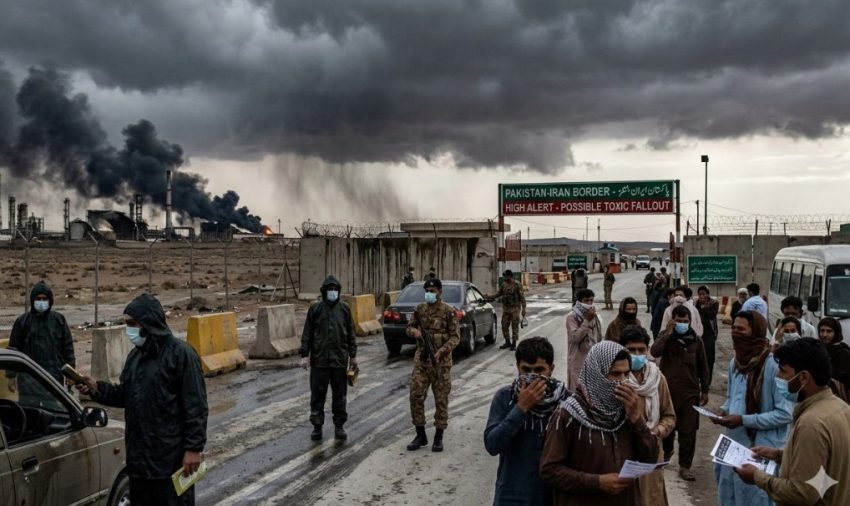
ISLAMABAD – Iranian capital Tehran was engulfed in thick toxic smoke after Israeli strikes hit fuel depots, sparking fires that burned for hours and reportedly caused black-colored rain miles away. As locals lamented breathing problems as oily rainfall stained streets, cars, and buildings across parts of the city, neighboring coutnries like Pakistan also brace for the impact.
Serious environmental concerns are emerging after intense bombardment of Iran’s oil storage facilities reportedly carried out by US and Israel. Experts warn that the attacks may have triggered dangerous atmospheric pollution, with reports of “black acid rain”.
The bombing of Iran’s oil reserves could lead to severe environmental catastrophe. The appearance of black acid rain in the Iranian capital is believed to be one of the early warning signals of this crisis.
So far, Pakistan has not yet experienced any effects from this black acid rain, but the situation is being closely monitored. Officials revealed that Iran’s weather data is currently unavailable because internet services have been disrupted during the ongoing conflict, limiting the ability to obtain real-time information.
Despite this challenge, meteorologists are tracking developments through satellite monitoring. They explain that Tehran lies toward the northwest, meaning that if pollution spreads, the first areas likely to be affected would be Afghanistan, not Pakistan.
However, experts caution that polluted particles and gases from Iran could still travel with westerly winds, potentially reaching Pakistan’s western regions. If that happens, air quality in those areas may deteriorate, raising concerns for public health and the environment.
Meteorologists note that the pollution cloud over Tehran is not yet spreading across a vast area, but the environmental implications remain worrying. Massive carbon emissions released by burning oil facilities could raise temperatures in the upper atmosphere, which in turn may increase the air’s ability to retain moisture.
This atmospheric shift could alter humidity levels and potentially affect future rainfall patterns across neighboring regions, creating long-term environmental consequences far beyond the immediate conflict zone.
Explosion in Riyadh as Missile Projectile kills two near major Saudi Air Base