

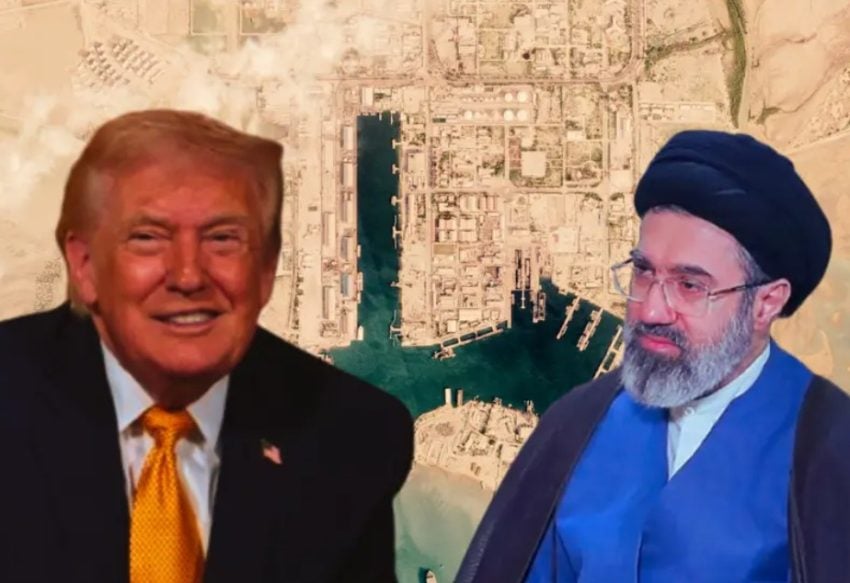
WASHINGTON – A two-week ceasefire between US and Iran temporarily halted a rapidly escalating conflict, with both nations declaring victory and presenting the agreement as a major diplomatic breakthrough.
US President Donald Trump described the outcome as a “total and complete victory,” insisting that Washington had already achieved all of its military objectives before agreeing to pause further attacks. The ceasefire announcement came less than two hours before a deadline set by Trump for Iran to reopen the strategic Strait of Hormuz or face intensified strikes on civilian infrastructure.
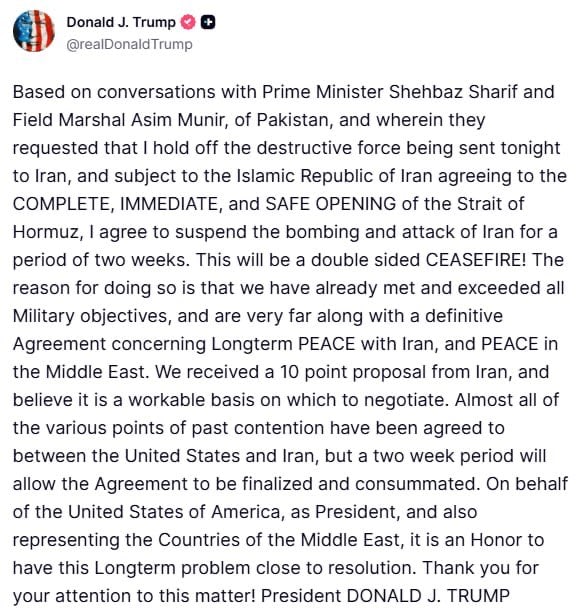
Trump said the decision to suspend military action followed urgent discussions with Shehbaz Sharif, Prime Minister of Pakistan, and Pakistan’s army chief Asim Munir, who reportedly urged Washington to hold off on further attacks. Under the agreement, the United States paused bombing operations for two weeks on the condition that Iran immediately allow the reopening of the Strait of Hormuz.
Calling the arrangement a “double-sided ceasefire,” Trump said the US had already exceeded its military goals and was close to reaching a broader agreement aimed at establishing long-term peace across the Middle East. He also revealed that Iran had presented a 10-point proposal that Washington believes could serve as the framework for negotiations. According to Trump, many longstanding disputes between the two countries have already been addressed, and the two-week pause will provide time to finalize a comprehensive deal.
A senior White House official confirmed that Israel has joined the ceasefire arrangement and has agreed to temporarily halt its own bombing campaign while diplomatic talks continue.
Meanwhile, Iranian leaders are portraying the ceasefire as a major strategic success for Tehran. In a statement issued by the Supreme National Security Council and reported by state media, Iran said its 10-point proposal focuses on key issues such as regulated passage through the Strait of Hormuz under the coordination of Iran’s armed forces. Officials claim this arrangement would strengthen Iran’s economic leverage and geopolitical influence in the region.
Iran’s foreign minister Seyed Abbas Araghchi said that during the two-week pause, ships will be able to travel safely through the Strait of Hormuz, provided the passage is coordinated with Iran’s military authorities and technical limitations are considered. Araghchi also expressed gratitude to Pakistan’s leadership for helping push both sides toward the ceasefire.
Behind the scenes, preparations are reportedly underway for possible face-to-face negotiations between American and Iranian officials in the coming days. US sources say the talks could potentially take place in Islamabad with Pakistani mediators present.
Potential participants from the US side include special envoy Steve Witkoff, Trump’s son-in-law Jared Kushner, and Vice President JD Vance, who is currently visiting Hungary and could add Islamabad to his travel schedule if negotiations move forward.
Following the ceasefire announcement, the US military has halted strikes inside Iran. According to the United States Central Command, American forces had already targeted more than 13,000 sites across Iran since the conflict began.
Iranian authorities, however, insist the ceasefire proves that their strategy succeeded. Iranian state media reported that Washington has effectively accepted key principles of Tehran’s proposal, including lifting primary and secondary US sanctions on Iran and withdrawing American combat forces from military bases across the region.
Tehran also claims the United States has acknowledged Iran’s authority over the Strait of Hormuz, saying that shipping through the vital waterway will take place under coordination with Iran’s armed forces.
Iran faces New Ultimatum of 8 PM tonight as Trump warns of Full‑Scale Attacks