Written by: Shakh e Nabat
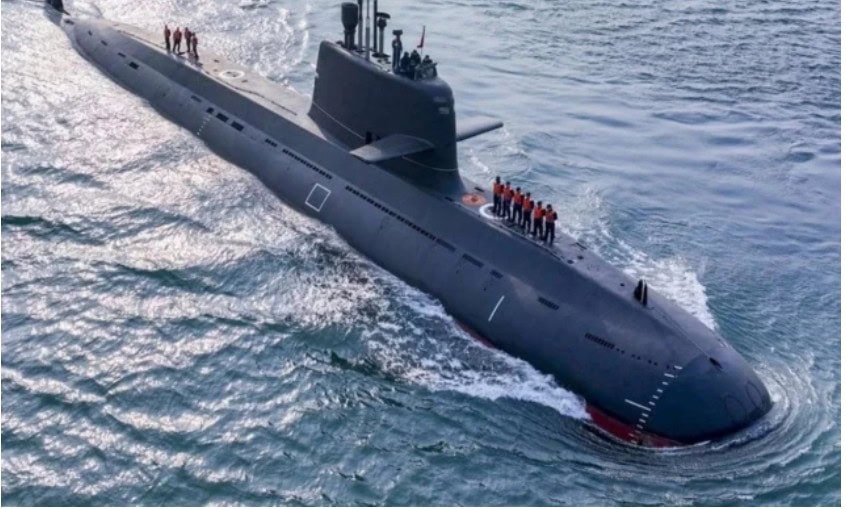
From Tench Class Submarine to Hangor, the Pakistan Navy has been progressing in Submarines’ Construction, Maintenance, and Operations. Hangor Class Submarine that is being built through a major defence contract between Pakistan and China Ship Building and Offshore Company Ltd. The Contract is based on a transfer of technology arrangement; in total, eight submarines will be built, four in China and the remaining four in Pakistan. The inclusion of the Hangor-class submarine in Pakistan’s naval fleet aligns with its sea-denial strategy and fulfils Pakistan’s operational needs in the Indian Ocean Region.
Hangor Class Submarine provides an operational advantage, as diesel-electric submarines cannot stay underwater for long and must surface to snorkel. The reason lies in its modus operandi. First, the batteries are used underwater for Submarine operation, but they gradually exhaust. To keep the Submarine operational, a diesel engine is used, which requires atmospheric oxygen, and that oxygen is available only near the surface of the water. Once the Submarine is above or near the surface for snorkelling, it runs on diesel and can recharge its batteries; the only problem, though, is its detection. It leaves the submarine vulnerable to attack.
For this specific reason, and given India’s increasing naval capabilities and capacity, a Submarine was needed that could fulfil the changing needs of deterrence at sea. Hangor Class Submarine’s air-independent propulsion technology, which is its unique selling point. It provides a third operating mode between batteries and diesel engines. With these, the batteries can generate electricity underwater without air.
In addition to that, Hangor-Class Submarine is also capable of carrying long-range torpedoes and cruise missiles. This adds to Pakistan’s Defensive posture and, if the demand arises, to its offence as well. It adds value to all vital naval operations at sea, such as conducting sea denial operations, protecting sea lines of communication, and even taking the offensive to the enemy’s shores. It is equipped with an advanced detection, tracking, and identification system above and below water through RADAR, Electronic Support Measures (ESM), Optronic Scopes, Hull-mounted array, Towed Array, and Mine avoidance sonars. This results in enhanced multi-domain operational capabilities and provides a precise assessment for tactical decision-making.
Due to its hydrodynamically optimised hull, sound-absorbing coating, raft-mounted machinery, and advanced acoustic management systems that significantly reduce detectability. It possesses a secure communication system and modern, encrypted data links that enhance situational awareness and enable communication with friendly forces or shore-based commanders, both of which are necessary for long underwater operations.
This is inevitable, given the threat emanating from India. Since 2016, Indian Naval Espionage activities have surged in and around Pakistan’s EEZ, evidenced by four incidents. In 2016, when Pakistan Navy detected and thwarted an Indian Type 209 Submarine’s attempt to intrude into Pakistan’s waters along the Makran Coast between Gwadar and Ormara. In 2019, a Kalvari-class submarine was detected at approximately 86 nautical miles from Pakistani Waters and was successfully pushed away. In 2021, another Indian submerged vessel entered Pakistan’s EEZ. This intrusion was successfully detected, and the adversary’s submarine was forced to leave the area. The most recent was in 2022, when the Pakistan Navy was conducting its SEASPARK-22 naval exercises. In addition to its ambitions to strengthen and expand its naval fleet, the goal is to operate more than 200 warships and submarines by 2035.
With these threats and ambitions, it was inevitable that the Pakistan Navy would equip itself with a Hangor-class submarine featuring an air-independent propulsion system to maintain its sea-denial strategy and credible deterrence at sea. The submarine contract with China, under the umbrella of technology transfer, is a breakthrough the Pakistan Navy needed to enhance its underwater combat capabilities. Hangor, derived from the advanced Chinese Type 039B Yuan-class submarine, was required to meet operational needs in the Indian Ocean region and is specially tailored to fulfil them.
With a total of eight submarines in Pakistan’s Naval fleet, growing threat from India and its overstretched claims of being a net security provider in the Indian Ocean region (IOR). It was necessary for Pakistan to expand its fleet to strengthen its underwater capabilities, and it did so through the inclusion of Hangor. It was inevitable for Pakistan in order to strengthen its role in the regional maritime domain. Though the Pakistan Navy possesses extraordinary capabilities to safeguard its waters and carry out necessary combat and rescue operations in the IOR, it still needs an advanced Submarine to enhance its role and effectiveness in the IOR.
By launching Operational Muhafizul Bahr to ensure the uninterrupted flow of national energy supplies and the security of sea lines of communication during the US-Israel-Iran War, the Pakistan Navy is playing its role in the regional maritime domain. The aim of the operation is to counter multi-national threats to national shipping and maritime trade. Pakistan’s 90% trade is conducted via sea; the operation was thus required to ensure that vital sea routes remained safe, secure, and uninterrupted amid a changing regional maritime security environment. With increasing responsibilities in the region, Pakistan needs to expand its fleet, and one major step towards that was equipping it with the Hangor-class submarine.