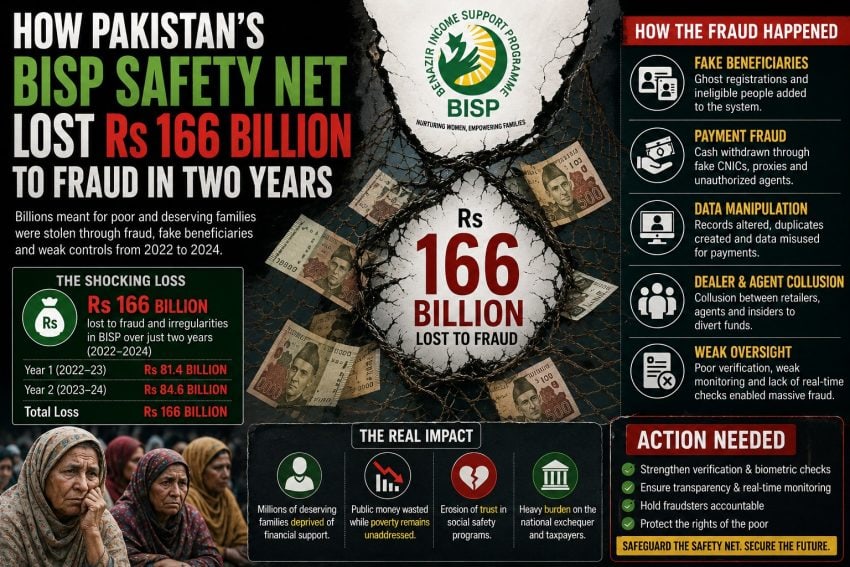
Pakistan’s Benazir Income Support Programme was built to catch the poorest households falling through the cracks of a collapsing economy. Eighteen years and roughly Rs 2.6 trillion in cumulative disbursements later, a different pattern has emerged alongside the poverty relief: BISP is both structurally inconsistent and one of the most consistently compromised cash-transfer systems in South Asia — audited, flagged, and re-flagged year after year by the country’s own auditors.
Structural Faults
The numbers don’t even agree with each other. Pakistan’s Finance Ministry, its own Economic Survey, and Chairperson statements have cited three different figures for the same FY2025-26 budget — Rs 716 billion, Rs 722.48 billion, and Rs 706 billion — a Rs 5–50 billion mismatch that recurs almost every budget cycle. Coverage is similarly uneven: BISP reaches roughly 58 million people, about a quarter of the population, yet Kafaalat covers only about a tenth of Pakistanis overall and just 18% of the poorest quintile specifically — precise targeting (two-thirds of beneficiaries come from the bottom two quintiles) paired with incomplete reach. And the programme shows no clear exit ramp: independent studies find it improves women’s decision-making and school enrollment, but there is no sign of boosting productive investment, functioning as consumption support rather than a path out of poverty. Pakistan’s poverty rate, 40.1%, is virtually unchanged since 2018, with 7 million more people now below the line.
The Corruption Record
The scale of fraud is not small. The Auditor General flagged Rs 141 billion in irregularities in FY2023-24 alone, then another Rs 25 billion in FY2024-25 — roughly Rs 166 billion across two years. In FY2023-24, over three million beneficiaries lacked a registered CNIC, yet Rs 116.95 billion was disbursed anyway, amid fake biometric verifications and payments to the dead. FY2024-25 found 601,850 ineligible beneficiaries paid, and Rs 515.7 million sent to 12,078 government employees and pensioners despite a 2019 cabinet ban on civil servants receiving BISP funds.
One ID Card, Multiple Payouts
The CNIC findings show the mechanism, not just the scale. BISP cross-checks a woman’s CNIC against her spouse’s to catch duplicates. FY2024-25 found 5,558 cases — Rs 239 million — in which one man’s CNIC was registered as “spouse” for multiple women, allowing a single identity to anchor several stipends. The inverse gap is bigger still: 596,252 files, Rs 25.46 billion, had no spouse CNIC on record at all. Over 600,000 cases combined show the same basic verification field either duplicated or left blank.
Not New
Between 2012 and 2015, 125,714 “ghost beneficiaries” drew ~Rs 3.3 billion, with one Sindh district alone producing over 10,000 fraudulent cases; no one was ever charged. A 2016 internal audit in Sindh separately found more than Rs 4.2 billion in fake entries, irregular procurement, and unverified debit-card withdrawals. In January 2023, the Auditor General told Parliament that Rs 19 billion had been paid to 143,000 officials — 2,500 of senior rank — via relatives’ names, and the FIA was ordered to investigate. A 2019 review found 140,000+ beneficiaries were themselves government employees, with nearly 37,000 later expelled from the rolls. A 2025 Public Accounts Committee sub-panel found roughly Rs 15 million paid out to deceased beneficiaries over the prior two years, and separate field reporting that same year documented bank staff and retailers allegedly skimming funds before they reached recipients — with district monitoring officials and law enforcement implicated too.
The Common Thread
Biometric and NADRA-linked checks were built to stop exactly this. They haven’t. Fraud has persisted through multiple technology upgrades, leadership changes, and inquiries — a failure of enforcement and accountability, not tools. BISP’s genuine benefits — women’s empowerment, school enrollment, decent targeting precision — are real. But a programme that can’t agree on its own budget and loses tens of billions annually to fraud isn’t simply imperfect; its leakage has become as institutionalised as its assistance.