
As a senior journalist who has tracked violence in Balochistan for years, I do not use the word “decisive” lightly. But what our security forces have achieved since July 5 deserves exactly that description — proof of what a determined state can achieve when it refuses to let terror dictate its future.
The trigger was brutal. Terrorists from Fitna al Khwarij ambushed police personnel in Ziarat’s Kach Mangi area, leaving nine police officers dead, including two station house officers, and abducting civilians and policemen from the scene. That assault, along with strikes elsewhere that together claimed 42 lives — soldiers, police, and ordinary citizens — was the work of Fitna al Khwarij and Fitna Al-Hindustan, proxies Islamabad says are directed from across the border. It fits a broader pattern: as Pakistan’s fortunes rise, so does the desperation of those who benefit from its instability.
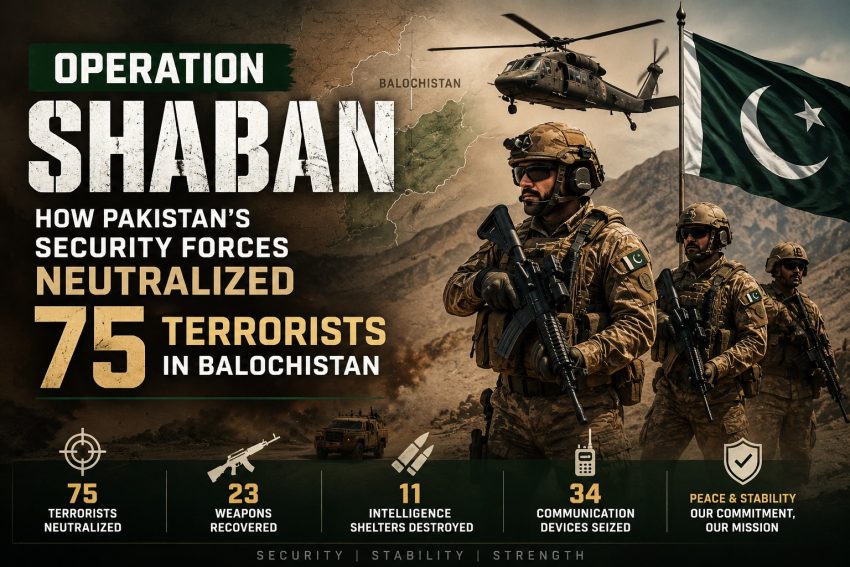
What followed was not hesitation but momentum. The Pakistan Army, Frontier Corps, and Balochistan Police moved jointly, launching Operation Shaban in direct response to the Mangi Dam attack. Within two days, 26 terrorists were eliminated, and the cordon tightened around fighters dug into the mountains through coordinated ground and aerial strikes. Thirteen more were killed within 24 hours. Then came Khuzdar: terrorists struck a police station in Zehri, and the response was immediate — eight killed on the spot, with five to six more falling to follow-up aerial operations. By Friday, the tally stood at 75 terrorists neutralised, reflecting both the scale of the threat and the resolve with which it was met.
These are not just numbers. Each one represents an attack that did not happen, a police station that stood, a family spared grief already visited on too many homes here. I find it hard not to feel pride in the professionalism this operation has shown — the coordination between ground and air assets, and the refusal to let the Ziarat ambush go unanswered. The Prime Minister was right to call this evidence of our forces’ high professional capability, and the President’s insistence that no proxy campaign will succeed reflects the resolve this moment demands.
Why is development the real target?
It is worth asking plainly: why do these groups fight so hard against roads, dams, and schools? Because development is their greatest enemy. They do not survive on ideology alone; they survive on grievance, isolation, and unemployment. A young man with a job, a road to market, and a school for his children has little reason to pick up a weapon for a cause dictated from across the border. Every CPEC milestone chips away at the conditions these networks need to recruit. Attacking a dam police station or highway checkpoint is not incidental — it is a calculated strike against the infrastructure of progress, because progress makes them irrelevant. A prosperous Balochistan integrated into CPEC 2.0 closes off the vacuum hostile actors have long exploited, making every terrorist neutralised here a defeat for that entire strategy.
Balochistan’s trajectory is, at last, bending toward progress — from Gwadar’s growing port activity to new roads through long-neglected districts. This is precisely why the threat is fighting back so violently, and why the state’s response cannot slow down.
But admiration should not tip into complacency. Seventy-five terrorists killed in five days tells us the network sustaining them is deep. Intelligence-sharing must be relentless, and porous border stretches enabling this violence must be sealed with equal urgency. Security gains should fuel a bigger development push — investment reaching high-recruitment districts, real opportunities for young Baloch men, and sustained support for the families of officers and soldiers who gave their lives.
Operation Shaban has shown that Pakistan’s security forces can act with speed and precision when tested, and that the state’s commitment to Balochistan’s future is non-negotiable. The next test is whether that momentum is matched by governance and real investment in its people. That is the operation that must never stop.