
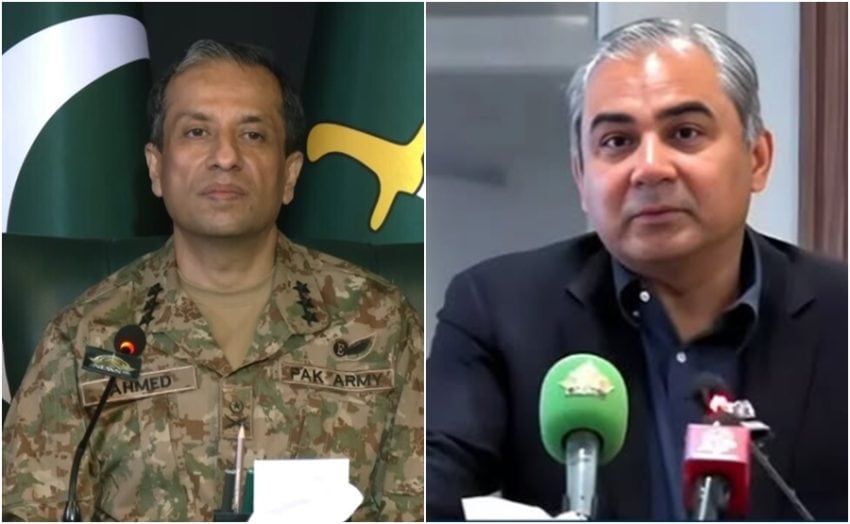
ISLAMABAD – Director General of Inter-Services Public Relations (ISPR) Lt Gen Ahmed Sharif Chaudhry held important press conference on national security and counter terrorism operations.
During QA session, the military’s media wing spokesperson distanced Armed forces from Interior Minister Mohsin Naqvi’s recent remarks on good governance and the need to create new provinces, making it clear that any such decision rests solely with the people, their elected representatives, and the democratic process.
DG ISPR said the interior minister expressed his personal opinion, as he refused to comment further on the statement. However, he underscored that good governance remains one of Pakistan’s most pressing national challenges, arguing that many of the country’s longstanding issues stem from weaknesses in governance and administrative structures.
#DGISPR remarks on the latest statement of Interior Minister Mohsin Naqvi
#ObligationComesFirst pic.twitter.com/optTMff2lu
— Muhammad Hanzala (@Hanzalamalik97) July 31, 2026
“Governance cannot remain static,” he said, adding that techn advancements, rapid population growth, and changing state requirements demand continuous administrative reforms.
Chaudhry said any decision on administrative restructuring, including the formation of new provinces, must be taken in accordance with the Constitution, the law, and through the will of the people as expressed by their elected leadership.
He pointed to the broad political consensus on the 14-point National Action Plan (NAP), saying both the government and the opposition agree on its implementation. He added that counterterrorism measures, madrasa reforms, and the repatriation of Afghan refugees are all integral parts of strengthening governance and improving the state’s administrative capacity.
Making a case for a national debate on governance reforms, the DG ISPR noted that Pakistan had a population of around 40 to 50 million with four provinces in 1972, whereas today the population has multiplied several times. He said it is reasonable to examine whether the existing administrative framework is capable of meeting the country’s current governance needs.
Reiterating that the armed forces have no role in determining such political matters, the military spokesperson said it is for political parties and the country’s elected leadership to decide whether administrative changes, including the creation of new provinces, are necessary to deliver better governance for the people.