

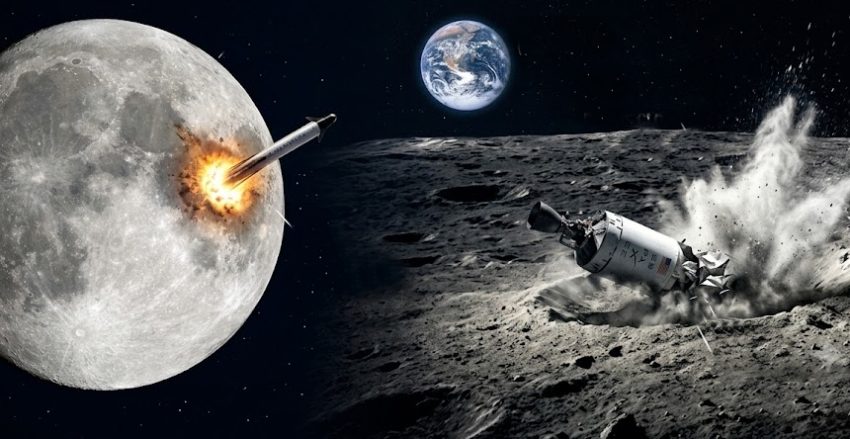
A massive piece of SpaceX rocket reportedly crashed into the Moon in rare space event that sparked global scientific interest, turning an accidental collision into unprecedented opportunity to study effects of human-made debris hitting lunar surface.
🚀 IMPACT ON THE MOON! A Falcon 9 rocket stage is about to collide with our natural satellite 🌕 On August 5, 2026, at approximately 06:35 UTC, an upper stage of a Falcon 9 will hit. pic.twitter.com/3SMl2becTu
— Stellarix (@Stellarixorine) August 5, 2026
The 4Ton kg upper section of Falcon 9 rocket, travelling through space at an incredible speed of around 2.43 kilometres per second (nearly 5,400 mph), was expected to strike the Moon near the Einstein Crater after drifting into an unexpected collision path.
The impact was predicted at around 07:35 BST, but the dramatic moment was not captured live because none of the spacecraft orbiting the Moon were positioned to witness the crash. Scientists are now waiting for detailed observations from powerful telescopes and lunar missions to confirm the impact and reveal the size of the scar left behind.
An out of control SpaceX booster from a Falcon 9 rocket crashed into the Moon at 1:35:37 am Eastern time on Wednesday morning. That should be around 10 to 30 seconds into the video. I can't see it. pic.twitter.com/zTQElVR3lb
— NashJeff (@JeffRielley) August 5, 2026
The crash could create fresh crater and giant dust plume, offering researchers a rare chance to study how objects behave when they collide with the Moon. Scientists will compare before-and-after images of the lunar surface to identify the new mark and analyse the damage caused by the impact.
NASA reassured that collision poses no danger to Earth, but described the event as a valuable scientific opportunity. Researchers hope the data collected from the impact will help improve space monitoring systems and strengthen techniques for tracking objects travelling beyond Earth.
TÁ SEM FREIO! FALCON 9 VAI BATER NA LUA!
O segundo estágio de um Falcon 9 lançado em 2024 vai impactar a superfície lunar na madrugada de amanhã. Estamos transmitindo ao vivo a trajetória atual do foguete, assista pelo canal Space Orbit no YouTube. pic.twitter.com/1brUxGjjcn— Pedro Pallotta – Space Orbit (@PallottaPedro) August 4, 2026
The rocket fragment came from a Falcon 9 mission launched in January 2025, which carried lunar landers and scientific equipment. While the rocket’s reusable booster successfully returned to Earth, the upper stage was left behind in space and eventually found itself on a one-way journey toward the Moon.
The crash site is believed to be near the Einstein Crater, located on the Moon’s sunlit side. Although the area can be observed from Earth, experts say the impact itself was impossible to see with the naked eye. Only advanced telescopes may detect a brief flash, while spacecraft such as NASA’s Lunar Reconnaissance Orbiter and South Korea’s Danuri probe will help investigate the aftermath.
Astronomers are pushing for unexpected lunar strike a “cosmic experiment”, as the dust cloud and newly formed crater could provide clues about the Moon’s surface and help scientists prepare for future space missions.
The incident also reignited fears over the growing problem of space debris. Scientists warn that as more countries and companies send missions beyond Earth, the number of abandoned human-made objects in space is rapidly increasing.
The Moon is now believed to have around 3,000 human-made objects scattered across its surface and surrounding environment, with a combined weight of nearly 190 tonnes.
Space experts caution that unchecked space pollution could create major challenges for future exploration, with some warning that increasing congestion around Earth and beyond could make future missions far more complicated.
Elon Musk’s SpaceX eyes $60Billion Deal for AI Startup Co-Founded by Pakistani Entrepreneur Sualeh